Servant Leadership in ACTion – Part 5: Working Together

Plan-Do-Check-Act in a circle, with the Plan, Do, and Check out of focus

(This is a continuing story – Part 4 is found here, or if you’re just dropping in please go here for Part 1)

After the Bosch presentations wound down, and the group got smaller, we changed the location for our meetings. In Lincoln, conference rooms were cleverly named by the paint color on the walls, we moved from the Red conference room to the White conference room. Of course, the White conference room was smaller, more intimate with ten chairs around two tables, arranged in a “U” (three sides), with a projector shining on the fourth wall of concrete blocks used on the outside of the building; you can imagine that the wall was painted white.

Our meetings were meandering, not focused, and frankly looking for something to do; we had checked off most of the issues from the complaint list by this time, either by solution, by handing off to the appropriate manager, or by tabling it as too hard. So, the group was looking for its next effort. I started discussing how projects could be started, including a lightweight portfolio management; none of this computed with them, their calipers weren’t calibrated for this kind of thinking yet.

Pivoting, I gave them a project – the File 5S project. In case you aren’t versed in 5S methodology, here is a small explanation:

5S (Five S) is a workplace organization method that uses a list of five terms – ‘sort’, ‘set in order’, ‘shine’, ‘standardize’, and ‘sustain’.

Wikipedia

The initiating issue was the share drive of the service organization, which allowed anyone to put anything out on it in any way they felt would work. And with this many anys, you can imagine – it was a mess.

It was, in retrospect, a perfect project. They all had felt the pain of trying to find something in the morass. People would just sling links in an email, and forget the diligent maintenance. Documents were in various states of use, non-use, and decrepitude. No one really understood it all, including me; I’d been there around 3 years at this time, and I still had to ask at times to find the right place.

I did set up some constraints on the group with this project. From a former life as an IT support person, I knew that putting spaces in a filename would make it harder to forward links through text-based platforms like email. From a former life as a data security responsible, I knew that documenting the responsible party for a file is important. And, from my life with this new location, I knew that a common structure would be helpful in navigating, but a rigid structure would be stifling and rejected.

We got to work; I made a proposal for the root of the drive – all departments would get a folder (SRA1, SRA2, SRA3, and SRA4). From there, the second layer would be also rigid (i.e. “100-OrganizationDocumentation”). The third layer, would be carried out by the department (i.e. “100.01-FocusGroup”). Subsequent layers (fourth and up) were at the discretion of the department, but could also be numbered directly.

We discussed, listened, and honed over what the second level was going to be; my recollection was that it was 6 folders. We documented our way through this, all agreeing to how this would operate, then we created our first folders. Then, we moved all the Focus Group documentation in (there was quite a bit by this time), using it as our test. Finally, we put the document on the root of the drive, calling it FileSystem5S.doc. We also created a plan, using the CIP Project Template (1 11×17 sheet with all elements of a small project, like the GANNT chart), and launched. We anticipated that this would be a yearlong project, and it turned out that we were right.

Fred, of course, gave the direction to the supervisors to start the movement in their organization. But, strategically, the supervisor had an ally – the department’s Focus Group member. They themselves, understanding and executing the vision, could assist with the movement, and develop what the department needed. One of their own was deeply involved, taking care of the file movement, and the attendant process changes. Progress was made, sometimes quite quickly.

We ended up choosing an easily-measured KPI – folders on the root. It was meant to be as low as possible, but not lower than 4. Transparency, ease of collection, and visible progress was assured by this counting.

There were inevitable squabbles over who was responsible, especially for dual-departmental use folders. There were some folders that no one claimed; they were eventually moved to a root “Archive” folder, and deleted after 6 months of no claim. There were difficulties with software like Bartender, which demanded a rigid structure. There were some that just didn’t want to move their folders out of familiarity. But, we all could see the numbers trending down, and the three first S’s (“sort, “set in order”, “shine”) were done equally and in parallel.

Certainly, there was much work going on, new ways to handle processes, new organizational capability addressed. Some folders were left empty, with just a file to show the new location for a few weeks. The review of the Archive folder was ongoing, and also coming down.

After 8 months or so, we were down to a few stubborn file structures; most were migrated by this time, and the last ones were the hardest. But, perseverance won, and by month twelve, we had four root folders, after we ceremonially deleted the Archive folder. We were at Standardize now!

But, one more last lesson was to be learned.

Probably about two months after Standardize was achieved, I was looking at the shared drive, and saw a new folder, sticking out conspicuously in our pristine root. I showed it to the Focus Group, and they only had one question for me: how to determine who created it. After showing them how to get this information, the folder disappeared – the respective member had taken care of it. The Focus Group was now monitoring and maintaining what we gave blood, sweat, and tears over; they learned that difficult things can be achieved together over an extended period.

This is also the first time I ever saw Sustain implemented effectively, over long periods of time, in any environment.

Servant Leader Lessons

Conceptualization – I saw the need, and created a vision (how could this share drive work for us)

Persuasion – I couldn’t manage this transition all on my own, I needed the help that the Focus Group brought, and they caught the vision without needing to be forced

Foresight – With prior experience, I brought the knowledge of not using spaces in file structures and aligning responsibility to a department as my enabling wisdom

Community – the Focus Group became a group here; accountable to one another, working together on cross-department folders, and encouraging to keep momentum up as the folder count went down

Healing – the Focus Group, who couldn’t think in systems a year ago are now guarding a system they built. The Focus Group also discovered they could do hard things together over time.

Servant Leadership in ACTion – Part 4: Directing Upward

Plan-Do-Check-Act in a circle, with the Plan, Do, and Check out of focus

(This is a continuing story – Part 3 is found here, or if you’re just dropping in please go here for Part 1)

The Focus Group, as we continued to press forward in the complaints given, started to uncover some larger issues, some that required holistic approaches – one of which was the wound of the takeover by Bosch. Acquired by Bosch three years before, with little change management beyond wall posters and paychecks – the site had really no idea about this proud company.

I however, had 20+ years with Bosch at this time, parachuting into a new community and a new location. Steeped in the training and culture of Bosch, I was an outsider to the Lincoln facility; shaped by processes I sometimes identified (management leadership development, outside training), and sometimes caught (need to understand German language/culture, moving around different organizations to broaden my view). To say I was a Bosch guy would be entirely accurate – I agreed with and upheld the Bosch Values, and had traveled to Germany enough to understand the cultural significance of decisions far away.

The stage was being set – the solution was to bring my understanding of Bosch to the Focus Group. I pondered over what was really necessary to understand, not to overwhelm, but to get a significant sense of how the company is built.

Digging in, I discovered something never known to me – the bedrock assumption that kept the independence of the company. Robert Bosch Industrietreuhand KG has a 93% stock voting rights, and has on its board some of the former managers of Bosch. However, Robert Bosch Stiftung GmbH (the foundation) holds 94% of the stock in value, and receives the profits to do good works. This balance, a governance model where power and profit are held in tension, where neither entity can consume the other without destroying itself, I saw as deeply innovative, and is very fitting for Bosch.

Building the presentation, I took this new learning, with a brief introduction of Robert Bosch himself. I then added some slides discussing the Bosch Values, and described the structure of the company. Three large business areas were next (with some example product divisions that would raise some eyebrows). Putting this into a presentation timed in at 20 minutes; enough to shift perspective without overwhelming.

The Focus Group got the first pass; sitting quietly as I unraveled this proud company to them, showing a glimpse of the company to whom they belonged. I received little feedback from them other than “everyone needs to hear this!”

This was the Focus Group’s first act of upward delegation — directing management to act on what they had discerned. And Fred and I couldn’t argue with it! So, Fred and I pondered this at our next one-on-one meeting together, and formed a plan – building a set of meetings, around 15 associates, twice per week, with mixed groups, registered with HR as a mandatory formal training. We got to work bringing the message to our service organization.

While I can’t say this was immediately healing to the associates of service, I did see some changes, some movement. For instance, I had heard more than once the complaint that it was better before Bosch came – without the realization that the company was foundering before it was acquired. This feedback stopped, and the organization seemed to accept a small part of the healing needed to keep pushing forward.


The Focus Group, however, had one more lesson, one that was not planned, one that was harder to swallow. Shelly had her powerful voice silenced, as she was terminated, the wolf at her door could not be forestalled.

Fred faced the questions, the ire of the group, the feelings of “me next”. While he sat and faced the onslaught, he understood that trust had been damaged, that healing will be slowed, that momentum would be diminished.

Ultimately the group decided to stay together, to effect change that they were already seeing was possible – wounded, but not defeated.

Servant Leader Lessons

Conceptualization – Fred and I saw the wound below the feedback, and knew it needed addressing; the Focus Group affirmed this and gave direction.

Stewardship – building a new way of looking at Bosch within a half-hour rather than forcing a larger and lower-valued training.

Community – Mixing the presentation groups brought disparate associates together into a first understanding of our working together

Healing – The Focus Group saw that not only did they need to know about Bosch, but all the organization needed this. They also needed healing from Shelly’s departure.

(This is a continuing story – please go here for Part 5)

Servant Leadership in ACTion – Part 3: First Steps in Trust

Plan-Do-Check-Act in a circle, with the Plan, Do, and Check out of focus

(This is a continuing story – Part 2 is found here, or if you’re just dropping in please go here for Part 1)

We promised to have a weekly meeting, so Fred and I had to discuss what this next meeting looked like. At the first meeting, we sent the participants (eight, as I recall) back to their departments with this message: please give us everything that is bothering you – important to you for us to address. It was a pretty bold ask, for the transparency we needed, as well as some anonymizing characteristics as they were given to this Focus Group member.

[I want to acknowledge the work of Fred here, the Focus Group (later the ACT) was my vision, but he truly caught this vision, and started driving the organization toward it. Fred, in a a staff meeting, had me introduce the vision of the Focus Group, and then explicitly directed all his supervisors to provide one member of their team toward the effort. This represented commitment, and the starting hints for his own transformation.]

What came back was pretty long, and we started to push the feedback into buckets – “this is easy” (in Bosch terms, just do it), “I can work on this” ( just do it with more effort), “this is tough” (going to need a project), and “this is impossible”. I remember that Fred picked off a few of the “this is easy” topics right away, giving the team some trust that the feedback was not only listened to, but acted upon.

Pretty much from the beginning, I started using the phrase lancing the boil, which Susan would scrunch up her face and give me a “eww” every time (along with attended nervous laughter). I eventually changed to using more appropriate corporate cultural language, but Susan and I still made references to it years later, as Susan was the only one who saw the totality of the group – even when she changed departments, she still stayed.

The pus was all over us, but trust was building.

Some of the “I can work on this” and “this is hard” topics related to HR policies in the location, which was also manufacturing product, and need to have these policies match between manufacturing and service. As the manufacturing was larger than service at this moment (two thirds to one third), it was clear where this focus would be.

Mildred, the HR manager of the site, had a very interesting relationship with Fred; they had grown up together in the site, both achieving beyond expectation, both now managers. They were brother and sister; sometimes playful, sometimes incendiary, all times loyal. I’m sure Fred was discussing what we were doing with the Focus Group with her, keeping her abreast of developments, showing progress on the Associate Satisfaction Survey, and striving to not run afoul of already set policy.

The arc was clear, though – having Fred in the middle, carrying messages back and forth from the Focus Group to Mildred was not going to scale; Mildred had to see for herself. Bringing her into the Focus Group, after a few months was a decision placed in front of all the members – she wasn’t invited without everyone saying yes.

Her first meeting, we brought Mildred to speed; what we had accomplished, what was still pending, and what we needed her input, effort, or even total commitment toward. She was justifiably conservative, knowing what this means, and what cost she would bear. But, I sensed a curiosity building in Mildred as well, as she recognized the potential of a group like this for manufacturing.

However, manufacturing was steeped in command/control leadership, and the organization change would have been significant. Instead, Mildred assembled this feedback a different way, building a suggestion system that was giving back real incentives (Bosch Bucks, used for swag purchases). The kicker was that the suggestion board applied also to service, so now the associates could earn for their ideas, and the Focus Group had other input for their evaluation.

We could see the faint outlines of an improvement group, improvement system, and a working group that would take us to the next turn of the flywheel.

Servant Leader Lessons

Growth – Fred directed supervisors to assign members, but something shifted. He started seeing these eight not as complaint-gatherers but as people worth developing

Community – The Focus Group members stopped being individuals collecting pain points. They became a team with shared identity, explaining the work back to their departments.

Stewardship – Fred picked off the easy wins, moving them into the done pile; as this became more significant, more feedback could be given to enhance trust.

Conceptualization – The Focus Group built mechanisms to sort feedback into actionable buckets, recognizing some problems as ‘impossible’ while clearing the path to address what could actually change.

(This is a continuing story – please go here for Part 4)

My basis for Leadership – Jesus

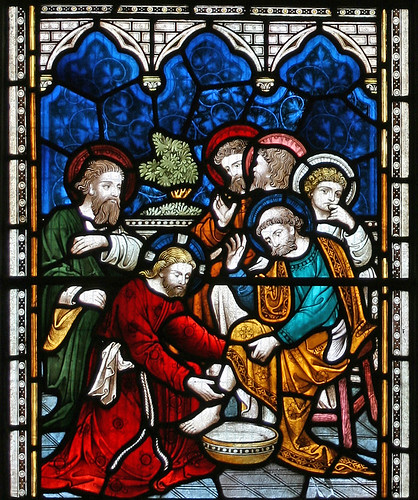
“Jesus washes his disciples feet, Soham” by TheRevSteve is licensed under CC BY-NC-SA 2.0

As a Christ-follower, my first and primary motivation for this posture of being a servant is Jesus himself.

You see, Jesus came not to rule, nor to make bad people good, but to save us – save us from our rebellious attitude toward God. He does this by showing us the way of His kingdom, and paying the price for our rebelliousness by giving up His own life – the ultimate act of service.

God authorized this by raising Jesus from the dead, something we celebrate every Easter.

This is great news!

Reversals (The Kingdom Way)

Jesus often spoke of the different way of His kingdom. He embodied the tension between overthrowing and working for the current world systems with one goal – God’s purpose in this world. This video does a great job of expressing this third way:

The Way of the Exile

This then, brings us back to leading by serving (a reversal). He shows that the power of leading comes from this attitude of laying down your rights/desires/motivations as a leader, and start by seeing others more important than yourself:

Jesus called them together and said, “You know that the rulers of the Gentiles lord it over them, and their high officials exercise authority over them. Not so with you. Instead, whoever wants to become great among you must be your servant, and whoever wants to be first must be your slave— just as the Son of Man did not come to be served, but to serve, and to give his life as a ransom for many.”

Matthew 20:24-28 (NIV)

So then, as one who isn’t part of the current system (an exile), and yet called to be part of the system, my desire for greatness is subverted, converted into servanthood.

However, Jesus doesn’t just leave us in this state. In fact, Jesus makes this astounding turn in the priestly prayer chapter of John:

I’ve told you these things for a purpose: that my joy might be your joy, and your joy wholly mature. This is my command: Love one another the way I loved you. This is the very best way to love. Put your life on the line for your friends. You are my friends when you do the things I command you. I’m no longer calling you servants because servants don’t understand what their master is thinking and planning. No, I’ve named you friends because I’ve let you in on everything I’ve heard from the Father

John 15:14-16 (The Message)

Jesus is the master of the next-level; by following his invitation to be a servant He mysteriously transforms us into His friend. He allows us to see what God is doing, and invites us into the decision!

Because of all this, I am a Christ-follower, and I strive to be a servant.

Basics of Servant Leadership

“gogogo” by SHANIDAN.COM is licensed under CC BY-NC 2.0

Robert Greenleaf is the acknowledged father of the discipline of Servant Leadership (although by no means the originator, as we will discuss in future posts). His model, though, is a good place to start our discussion:

Servant leadership is a philosophy and set of practices that enriches the lives of individuals, builds better organizations and ultimately creates a more just and caring world.

Robert Greenleaf

He describes this Servant Leader moving into 3 distinct phases:

  • The Natural Desire“It begins with the natural feeling that one wants to serve, to serve first”
  • The Conscious Choice – “Then conscious choice brings one to aspire to lead…”
  • The Best Test – “The best test, and difficult to administer, is: do those served grow as persons…”

I can attest to this natural flow in my life, as someone who is serving eventually comes to a place where giving to a group puts you into a natural leadership position. It doesn’t come from desiring or pulling this leadership role -grasping for it will result in other leadership styles.

Greenleaf’s determination of success, then, is not directly tied to the leader, but to the group being served. As this is difficult to measure, and reflected in the natural human choices of the group being served, it is doubtful that any performance indicator can be made for this kind of leader.

This philosophy has far-reaching consequences, and is the burning desire of this blog.