
Servant Leaders Set the Table

I watched something happen recently that I didn’t plan.

A man who had poured nearly fifty years into a volunteer organization was facing its end. He’d built it, rebuilt it after it collapsed once before, and now — with his own health declining — he was preparing to attend what he believed might be the final gathering. The eulogy was half-written in his head.

At the same time, a woman appeared. A retired educator who had spent her career turning failing institutions into thriving ones. She didn’t have the typical credentials the group expected. She didn’t fit the profile. But she had fire, and she had a vision that started not with programs or curriculum but with a spaghetti dinner — gathering people around a table before asking them to do anything else.

My role was small. I introduced them. Not to the person — I introduced her to his story. I told her about his faithfulness, his quiet generosity, the decades of showing up when no one was watching. I told him (in front of the people who would carry the work forward) what I’d seen him do, in plain language, without exaggeration, because absolutely none was needed.

That night, this man received something vision can’t provide: the knowledge that someone saw his faithfulness and spoke it out loud to the people who needed to hear it. He didn’t need another award – he had plenty of those. He needed to be known — not evaluated, not recognized from a stage, but known by someone who could tell his story to the person who would carry it next.

And the woman who walked in without the expected credentials? She didn’t need permission. She needed context. She needed to understand that what she was inheriting wasn’t a failing organization; it was a living legacy built by someone who would move heaven and earth to get to yes.

The servant leader’s gift in that moment wasn’t eloquence or strategy. It was the willingness to make someone else’s story the center of the room. To bear witness to another person’s faithfulness without any benefit to yourself. To give someone else eyes. And to stay quiet when the connections happen.


Servant leadership is setting tables you don’t sit at the head of. And the most important ingredient isn’t the agenda or the program or the strategy.

It’s knowing who needs to be in the room — and then getting out of the way.

Servant Leadership in ACTion – Part 1: The background

Servant Leadership will bring you to many places not defined by organization and process, but by need and desire. This series picks up my experience of ACT (Associate CIP Team), tying the characteristics to a group that far exceeded even my lofty vision!

The Need Defined

Bosch, in its inimitable way, has many curious processes – being a worldwide company with German roots leads to interesting congruities. One such method (at least until 2021) was the all-associate satisfaction survey, performed every other year. As I started reporting to the Lincoln site in 2011, AS11 was getting completed. As expected, results took quite a long time to compile, present to different layers of management, and filter down to operational departments; so the results were down to our department in early 2012.

The Review

Just before this was delivered, I had received my yearly review, and my first review since moving to Lincoln. It must have been hard for the manager there (let’s call him Fred) to evaluate me; I started reporting to him in April, I spent months in Mexico implementing a new ERP system, and had spent little time in the Lincoln facility. So, when Fred got the task of building my review, he had scant evidence.

I had made a small comment in a moment of pique to a fellow associate, saying that “if I start using large words, you know I am angry”. This had somehow bubbled up to Fred, and this phrase landed on my review, especially in the area of communication. It stung, and I still remember the hot face I had when he delivered it to me; here I am, delivering Servant Leader principles, and I have this impediment drawn in full display. I felt it was unfair, but, as we teach NYLT youth, feedback is a gift (not expressed is the way it should be treated as one you desired). I did, however, in the wisdom of the moment, ask that Fred alert me if he sees such behavior so I can quickly remediate, so this also stood on my review (and, as you may imagine, never showed again).

Back to the Survey

Fred, finally gaining access to the survey results, felt defeated, and helpless; they were significantly bad, and seemingly worse than the last survey of AS09. He had to report through the layers about how this would be fixed. In a small meeting we had, he expressed frustration and impotence in changing the outlook of the organization.

I had another experience at Bosch with these surveys, and even bad ones; the idea that took hold of the VP in charge of that organization was one of Focus Groups – selected individuals from relevant departments that could tease the feedback out of the (rather generic) result, giving a measure that is specific, measurable, attainable, realistic, and time-based (or timely) – most of you already know about SMART goals.

Upon giving this idea to Fred, and outlining the strategy and possibilities, plus offering my effort and direction to organize it, Fred immediately recognized a solution, a move forward, and the possibility to gain some traction with the organization. He approved the Focus Group idea, and had me share it at the next staff meeting, so that each department could give one or more associates to this. I gave Fred a vision!

Servant Leader Lessons

As a Servant Leader, I exercised foresight as I brought lessons from the past forward, with a heavy dose of persuasion as I laid out these plans to Fred, and ultimately to all the other staff members. Plus, I had to do some healing for myself, as I processed the feedback from Fred on my review, increasing my awareness of how I could communicate to this new organization.

(This is a continuing story – please go here for Part 2)

My basis for Leadership – Jesus

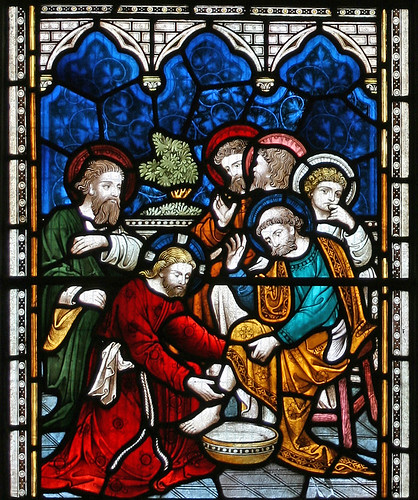
“Jesus washes his disciples feet, Soham” by TheRevSteve is licensed under CC BY-NC-SA 2.0

As a Christ-follower, my first and primary motivation for this posture of being a servant is Jesus himself.

You see, Jesus came not to rule, nor to make bad people good, but to save us – save us from our rebellious attitude toward God. He does this by showing us the way of His kingdom, and paying the price for our rebelliousness by giving up His own life – the ultimate act of service.

God authorized this by raising Jesus from the dead, something we celebrate every Easter.

This is great news!

Reversals (The Kingdom Way)

Jesus often spoke of the different way of His kingdom. He embodied the tension between overthrowing and working for the current world systems with one goal – God’s purpose in this world. This video does a great job of expressing this third way:

The Way of the Exile

This then, brings us back to leading by serving (a reversal). He shows that the power of leading comes from this attitude of laying down your rights/desires/motivations as a leader, and start by seeing others more important than yourself:

Jesus called them together and said, “You know that the rulers of the Gentiles lord it over them, and their high officials exercise authority over them. Not so with you. Instead, whoever wants to become great among you must be your servant, and whoever wants to be first must be your slave— just as the Son of Man did not come to be served, but to serve, and to give his life as a ransom for many.”

Matthew 20:24-28 (NIV)

So then, as one who isn’t part of the current system (an exile), and yet called to be part of the system, my desire for greatness is subverted, converted into servanthood.

However, Jesus doesn’t just leave us in this state. In fact, Jesus makes this astounding turn in the priestly prayer chapter of John:

I’ve told you these things for a purpose: that my joy might be your joy, and your joy wholly mature. This is my command: Love one another the way I loved you. This is the very best way to love. Put your life on the line for your friends. You are my friends when you do the things I command you. I’m no longer calling you servants because servants don’t understand what their master is thinking and planning. No, I’ve named you friends because I’ve let you in on everything I’ve heard from the Father

John 15:14-16 (The Message)

Jesus is the master of the next-level; by following his invitation to be a servant He mysteriously transforms us into His friend. He allows us to see what God is doing, and invites us into the decision!

Because of all this, I am a Christ-follower, and I strive to be a servant.