Sometimes life hands you a wry observation, and the absurdity lands directly on humor. In this case, it’s Sallman’s ethereal, perfectly composed Jesus — the product of careful artistry, mass-produced reverence, decades of dignified church walls — keeping solemn watch over… someone’s hastily scribbled “Restroom” note, probably written on whatever paper was handy and taped up with packing tape.
The contrast is perfect. The eternal and the immediate. The carefully crafted and the “we need a sign right now.” The sacred portrait and the practical scrawl.
It’s like the whole history of trying to make faith proper and presentable, presiding over the reality that most of life is hastily scribbled notes and making do with what you have. The gap between our careful theology and our “we need a bathroom sign” moments.
And somehow Jesus is there for both. The reverent portrait and the scribbled necessity. Not choosing sides, just… present.
Watching over the whole beautiful, ridiculous, very human mess of it.
Servant leaders do this often, and a childlike view of the world is all it takes. Seeing the edges, noticing. Laughing at the absurdity. Not the sarcastic, the bawdy, not at the expense of others, but the joy of connecting, of seeing, of delighting.
And then there’s Robert Greenleaf:
Choosing to give us a last wry look over his life, knowing that his serious works live in the tension of who he was as a person, a human.
My admonishment to you today is to slough off the serious demeanor, to be open to what life gives, and to heartily laugh when the time comes for it.
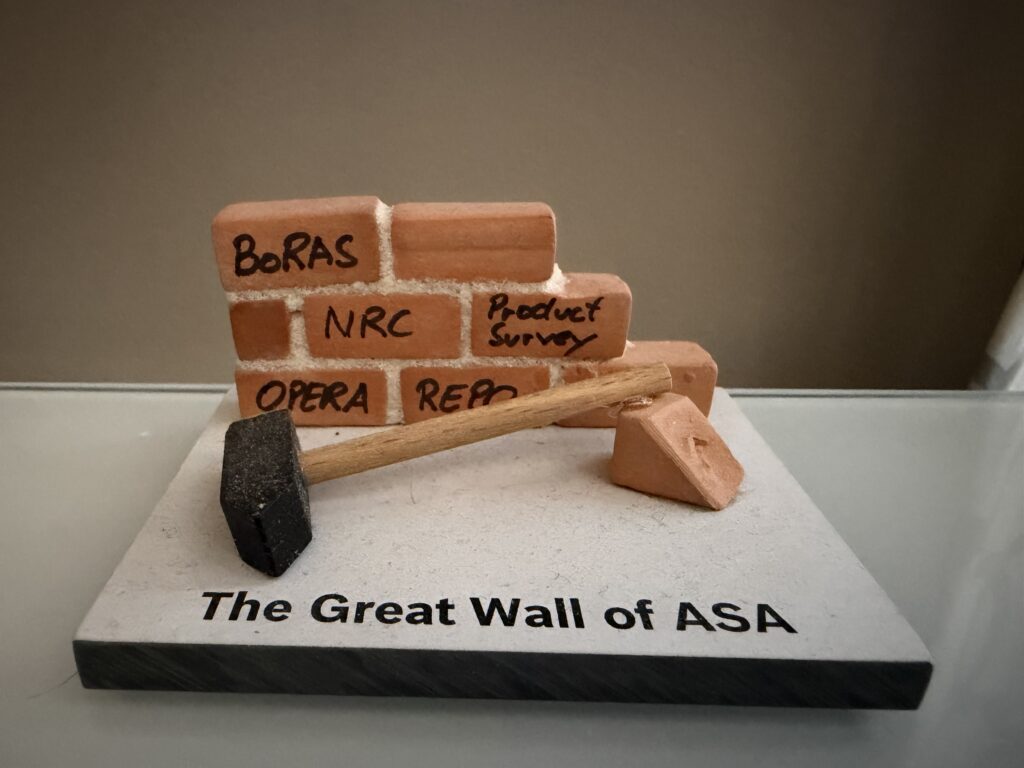
This morning, I am contemplating a small desk ornament, a testament of my time at Bosch. A time, where we shut down many small legacy systems, and spun up SAP to replace them.
This was a hard project – integrations are never easy, but ripping and replacing – this is difficult and painstaking work. Living in fear of regression – of users wanting their old systems back, we stuck to the task of building something new. The sledgehammer shown was insightful as a metaphor.
But, my reflection today is not the past; it is the present – a wall.
Servant leaders find walls all the time as they interact with others. Some walls are God-given, some are protecting wounds, some are just neutral space – but all are protecting something.
The temptation is to swing the sledgehammer, especially at walls we sense are hiding a wound. To get in, to fix, to force healing – isn’t this the way to help others?
To these motivations (which I am subject to as well), I raise one word – patience.
Sometimes, as a servant leader traces the boundary, an entrance emerges. This entrance may be small, may not even be seen easily, but certainly one left as the boundary was constructed.
And this is the place for the servant leader – not to smash in a weak place, but to softly knock. Softly knocking, as a request for attention, a gentle request, an invited entrance.
Jesus does this for us as well:
“Look! I stand at the door and knock. If you hear my voice and open the door, I will come in, and we will share a meal together as friends. – Revelation 3:20 NLT
Give the person you are serving the chance to see your patience, to invite you in, and to spend time within their boundary as a place of fellowship.
I’ve written earlier about how a servant leader struggles with their impact. But what happens when the positive measurement is brought to you?
In the life of the servant leader, sometimes comes recognition that this leader has impact, and others recognize this. It may be in the currency of compliments, awards, or even compensation.
I use a test myself to measure the guardrails of the servant leader, to make sure the desire to serve remains the utmost goal:
Did I seek this?
A recognition sought by any means is anathema to the servant leader. Awareness must be brought to the motives of the leader, and purging of the dross must happen, else The Impostor is reigning. He is cunning, skillful, and corrupting, and must be diligently guarded against.
Should I share this?
Rarely is recognition of a leader happening in a vacuum, but it is a reflection of those being led. Broadening the context of the recognition, giving due to the community that the leader serves, is modeling the Best Test when it would be tempting to keep the recognition to yourself.
Does this feel like just flattery?
Sometimes recognition is given that is bereft of meaning. Recognition like this can be met with grace, depending on the giver – someone in power may not be ready to hear rejection.
Sharp awareness when this type of recognition is given avoids the regrets later — holding it loosely, allowing it to drain away, defeating the haunting chimes of The Impostor taking hold.
Is the group giving this?
A group well-served may choose to give regard to the leader. These moments can be deeply satisfying, but also raise underlying tension, as the group may feel led rather than supported. Addressing these moments when they come is recognition as well. Sometimes a skillful reversal, a pull-in of the group is warranted; sometimes meeting it with uncomfortable grace is best.
When recognition has come to my life, I have not always been up to the task, been blindsided by it, and caught in its charm. The Impostor is always close at hand. But asking these questions quickly forms the wall I need, the wisdom to detect sincerity.
The cost of servant leadership is not without reward, just that the rewards must be worthy of the cost.
(This is a continuing story – please go here for Part 1)
I know that I called this series “Servant Leadership in ACTion”, explicitly using the term ACT, which stood for Associate CIP Team – but ACT is a later construction. We really started this under my term for the group, which I used so much creativity to construct – the Focus Group.
My vision before the first Focus Group meeting was for this group to solve their own problems. In the immortal words of Helmuth von Moltke the Elder, “Kein Operationsplan reicht mit einiger Sicherheit über das erste Zusammentreffen mit der feindlichen Hauptmacht hinaus“, or for us English speakers, “No plan of operations extends with any certainty beyond the first encounter with the main enemy forces.“
Fear and trepidation drove me into the first Focus Group meeting. I’d assembled the Associate Satisfaction Survey results, prepared potential solutions to prime the pump, arranged the conference room. I was trying to control what I couldn’t yet trust.
The survey gave us indicators – ‘I have confidence in my management,’ ‘I feel valued at work’ – consolidated feedback, on forced questions, that could be universally applied, but said nothing about the “why” of the selection.
As the meeting started, and I walked through the feedback charts and graphs, I felt naked, exposed in ways I could not express. The results from the Associate Satisfaction Survey were inadequate to describe the conditions participants faced, and I felt the full weight of their scorn.
Their pain was visceral. The time clock was a significant impediment, even though HR had constructed policies that, at least from the management side, felt generous. One participant – I’ll call her Shelly – had just had a baby. Attendance issues were the wolf at her door, and she responded in anger to what she was facing.
Fred was silent for most of the meeting, only enumerating the policies (which I didn’t really know, being new to the location, and not subject to the time clock).
Shelly was not having it.
The impasse was palpable and felt insurmountable. Yet we could not focus on Shelly’s issues alone – all eight participants had needs, and they represented departments full of other needs.
We moved into my blank slides and abandoned the Associate Satisfaction Survey quickly. It didn’t resonate. It formed a ‘management thinks’ hedge against the ‘I’m feeling’ desperation. But this first meeting was wild. Almost a visceral snarling of a caged animal finally having a hand stuck into their domain, a hand that could be mauled.
I felt the mauling. I was new to the organization, new to the location, and I was a ‘Bosch guy.’ This location had been integrated three years prior, but no change activity or development had been done. They didn’t know the history of Bosch. They didn’t really know how they were contributing. All Bosch was to them was a paycheck and a smattering of logos and platitude signs.
I came in with 25 years of Bosch – knowing the tempo of how it operates, experience with the German culture embedded deeply inside the company even though they try to excise it. It is a proud heritage, even a noble one, one that has stood over 100 years. However, the fact that they did not know any of this was a deep wound that no one had acknowledged.
I started gathering pain points from the participants. Shelly was vocal – but I didn’t let her dominate. It was me typing furiously to capture this initial set. Not just the time clock issues, but others. Two or three slides that I remember. The meeting ended with just open questions on slides and a request to gather more from their departments.
Fred and I, a little worse for wear, said little to each other as we hunkered down for the next storm.
Later Revelations upon Reflection
Shelly needed resolution for the impossible tension between being a new mother and the time clock’s demands. Not a policy explanation. Not optimization. Resolution – which might mean changing the system itself, or might mean something else entirely that could only emerge through genuine engagement with her wound.
I didn’t know that in the first meeting. I just knew my prepared deck was worthless and their snarling was real.
The Inadequacy of “Others-First”
I came into that first Focus Group meeting as an “Others-First” leader. I’d assembled the data. I’d prepared solutions. I was ready to help them solve their problems efficiently so they could be more productive, more engaged, more aligned with organizational goals.
But “Others-First” leadership has no space for the visceral snarling of people who’ve been ignored for three years. It has no response to Shelly’s wolf at the door beyond enumerating policies. It treats wounds as problems to be solved rather than pain to be honored.
The blank slides weren’t a technique. They were surrender. I had to abandon my prepared solutions because servant leadership requires what NYLT calls the EAR model – allowing people to Express their wounds, the leader Addressing and upholding that pain, and creating space to Resolve (not solve) what they’re experiencing.
Servant Leader Lessons
As we moved through the meeting, I felt the stirring of new lessons that were deeply applicable:
Listening – not to gather data for optimization, but because Shelly and the others had inherent worth and wisdom that deserved reverence. Even when that listening meant sitting in the mauling. Even when their snarling exposed my inadequacy.
Awareness – not keeping an eye out for disturbances I could manage, but turning the spotlight inward first. I had to surface my own awful truth: I was the Bosch guy carrying 25 years of corporate culture into a wound no one had acknowledged. My prepared solutions were part of the problem, not the answer.
(This is a continuing story – please go here for Part 3)
When searching for content about Servant Leadership, I’ve seen it in hundreds of LinkedIn posts, books about how to “effectively serve while leading”, even the BSA NYLT curriculum. This is a pseudo-form of Servant Leadership, and right now, I’m calling it what it really is:
It’s really “Others-First” Leadership.
It has many expressions:
“Others-First” leadership has motivation to help others, while secretly wanting to call back to itself, to use the language of service while remaining fundamentally self-oriented
“Others-first” leadership cloaks selfish ambition, hiding behind the tenets of holistic philosophy, taking a shortcut though the dark places of our soul
“Others-first” leadership only uses the principles that may help; only asking how to lead in a way that serves others
“Others-first” leadership is fundamentally about the leader being good at leading, of considering technique, optimization, and performance hacking the highest standard
What Was Lost
We’ve lost the inner orientation – the spiritual/philosophical/moral foundation that makes servant leadership more than just enlightened self-interest. We’ve lost the soul and power of how leaders fundamentally serve.
Witness the progression that happened in the last 50 years. Greenleaf discovers Servant-Leadership (although I would contend that he elucidates it). He builds a masterpiece of a library, of his talks and thoughts (although others would struggle to find organization in this chaotic struggle he faced). Spears picked this up, and developed 10 characteristics, giving more feet to how servant leaders really act and operate. Consultants and other marketers see a list, and know right away it can be packaged into bite-sized chunks, without the struggle that Greenleaf and Spears underwent. And, now we’re left with principles without the life-giving force that gives them power!
How to Recognize the Difference
Robert Greenleaf was clear about this:
Servant leadership is a philosophy and set of practices that enriches the lives of individuals, builds better organizations and ultimately creates a more just and caring world
We quickly and easily to move to “set of practices”, without considering the philosophy behind. These practices, while valuable, considerate, and helpful, come from the philosophy first and foremost – the deep well of decision to serve, to set your life aside, to consider others above yourself, to disappear in the flow.
Corruption or bypassing this philosophy is subtle, but striking when you see it. Take Spear’s 10 principles:
Listening – The “Others-First” leader listens to people because engaged people are productive, work harder, and express loyalty toward organizational goals. The Servant Leader listens because they believe that people have inherent worth and wisdom that deserves reverence, even when the listening gets hard.
Empathy – The “Others-First” leader understands the emotional states of those they lead just to help manage people effectively, building rapport that increases their influence, connecting to improve performance. The Servant Leader gives the person honor and understanding of their experience from within their frame of reference, placing themselves in that person’s position, walking in their shoes to respond to their wholeness as two image bearers of God.
Healing – The “Others-First” leader brings healing because healed people can feel oriented, and have a veneer of security and stability. Servant Leaders bring healing because brokenness is a condition of humanity, and this patient application of soul-change will allow the person to flourish
Awareness – The “Others-First” leader keeps a keen eye out for disturbances in the people they lead to head off potential issues later, and never turns the spotlight to their own soul. Servant Leaders bring awareness from themselves (inside-out) to others, uncovering their own awful truths, surfacing conflict, healing the wounds that revelations make.
Persuasion – The “Others-First” leader employs tactics to head toward agreement, even to the point of manipulation; it is really “command-and-control” in a friendly, smiling package. The Servant Leader employs humble openness, holding ideas and direction loosely, knowing that the best solution usually doesn’t reside with just one person.
Conceptualization – The “Others-First” leader sees what is best for themselves or the organization, and focuses their efforts to conform to this understanding (the very nature of “Human Resources”). The Servant Leader sees each person’s unique potential and dreams, believing organizational prosperity flows naturally from human flourishing rather than conformity to institutional objectives.
Foresight – The “Others-First” leader sees the future as potential risk, and takes steps to avoid failure, often papering over this frantic activity with documentation like risk registers. The Servant Leader embraces intuition, slows the emotional roll, applies their moral grounding, builds time into the decision, and feels settled in its application before building any documentation for the organization.
Stewardship – The “Others-First” leader manages resources and people effectively and competently, toward organizational effectiveness and waste minimization. The Servant Leader holds resources and people in sacred trust, knowing they are a temporary caretaker that is responsible to those served, future generations, and the God who provided them.
Growth – The “Others-First” leader embraces the person and equips them to be the best worker they can be (training, mentoring, even other development work) . The Servant Leader sees the person as a whole person, invests in their complete development, bringing out the best worker as a byproduct.
Community – The “Others-First” leader builds coalitions, with an improvement direction, even cohesiveness for all members (shared organizational goals, improved metrics). The Servant Leader creates genuine community where members serve the growth of each other, take unlimited liability for each other’s wellbeing, and willingly sacrifice personal advancement for communal flourishing.
Do you see the difference? Do you see the subtle corruption?
I’ve cloaked myself in powerless “others-first” leadership – it’s seductive, shows well on a CV, and makes you a marketable entity. Some of these blog posts, and LinkedIn content, upon further reflection, take this counterfeit stance. I’m declaring that this stops right now!
Hearing from the Founder
I’ve stood at Robert’s grave, looking at my own life, in the shadow of this giant, wondering if I will ever have the impact he did in his 86 years – impact that did not come from just going through the motions of identifying and promoting good principles.
I’ve stood at Robert’s grave, considering his claim to life – “Servant-Leader, Philosopher, Writer”. He didn’t start with what he did (philosophy, writing) – he started with his identity – Servant-Leader. An identity rooted in the wisdom of the ages – a deep understanding of taking up his cross, casting aside all grasping, and resting.
I’ve stood at Robert’s grave, looking and pondering the meaning of his epitaph: Potentially a good plumber, ruined by a sophisticated education. He’s calling us, in the humor of the philosopher, to something larger than ourselves. He’s sticking out his tongue at us; to not take ourselves too seriously, to jump into the flow of service and follow it to the place of impact.
The Call to Restoration
The call of Jesus is clear and unmistakeable; we must strap on the towel and wash the feet of those we serve, without any grasping of attention, or feeding our self-ambition. God will exalt us, just as He exalted Jesus:
Think of yourselves the way Christ Jesus thought of himself. He had equal status with God but didn’t think so much of himself that he had to cling to the advantages of that status no matter what. Not at all. When the time came, he set aside the privileges of deity and took on the status of a slave, became human! Having become human, he stayed human. It was an incredibly humbling process. He didn’t claim special privileges. Instead, he lived a selfless, obedient life and then died a selfless, obedient death—and the worst kind of death at that—a crucifixion.
Because of that obedience, God lifted him high and honored him far beyond anyone or anything, ever, so that all created beings in heaven and on earth—even those long ago dead and buried—will bow in worship before this Jesus Christ, and call out in praise that he is the Master of all, to the glorious honor of God the Father.
Today, I had an opportunity to spend some time with our new NYLT leaders – youth that have taken the course, and now wish to lead the next one. It was a grand time of rekindling their friendships, to get to know each other, play games, and learn what the course requires.
I know that my ears pricked up when I heard the Senior Patrol Leader announce that they would be moving into the Servant Leader module, and I moved from being in the kitchen, to being with the youth.
The SPL spent some time describing the difference between top-down leadership, and bottom up leadership – all using a pyramid, with the leader at the apex – the lesson being that inverted pyramids are at the heart of the Scouting program, as supportive and helpful leaders are what we are developing.
However, the SPL was tripped up by the final quote, meant to be a discussion point:
[Servant leadership] begins with the natural feeling that one wants to serve, to serve first. Then conscious choice brings one to aspire to lead — Robert Greenleaf
He was confused by the economical and paradoxical way of Greenleaf; in fact, I asked him to read the quote a few times as words were missed and jumbled.
He then asked “What this quote means to you?” He received a few responses, some heading toward others-first leadership, some talking about wanting to serve — standard fare for the first time entering into the deep world of Servant Leadership.
As the group started to wind down, I couldn’t help but to put up my hand.
Acknowledged, I then moved into my understanding of this quote — the basic desire of us to serve one another (like listening and empathy and healing). Then, the choice, the recognition that leading others is the effective way of serving.
This didn’t compute, didn’t land with the youth. So, I doubled back and asked the question: why does everyone else want to lead? They were quick to respond — money, power, status — they’ve seen what the wider world has to offer. I then asked the question what if you wanted to serve others, to offer things to them that will improve their lives; they were on board, wanting to improve others. The ultimate question remained – what happens when you recognize that, by leading others, you multiply this service; and I saw the recognition start to dawn.
Pulling out the best test was next – Greenleaf’s formation of how to evaluate servant leaders: is the group getting better, growing stronger, becoming servant leaders themselves?
Now the quiet reigned as they saw not only the leader challenge, but the impact, the significance, the humble walk.
I finished with a closing remark – “I’m spent a lifetime chasing this, and I still don’t have it all figured out either.”
3 minutes to discuss, a lifetime to chase, a calling of Jesus to follow.
I’ve engaged with a number of other management philosophies, and they seem to come down to a set of criteria that define good management skills. For instance, from Indeed – 5 Essential Management Skills:
Leadership – including skills such as decisiveness, team building, empathy, conflict management, and motivating others
Planning – including vision, critical thinking, flexibility, and problem-solving skills
Strategy – including creativity, conflict resolution, and problem-solving
Communication – including listening, negotiation, persuasion, building relationships, teamwork
Organization – including goal setting, project management, time management, and scheduling
You can certainly notice that some of the Servant Leader principles already show up directly. Indirectly, there are many more we can check off – vision is covered by conceptualization, for example.
However, Robert Greenleaf probably said this best, in the economic way he defines:
It is the ability to state a goal and reach it, through the efforts of other people, and satisfy those whose judgement one respects, under conditions of stress.
Robert Greenleaf, Something to Hope For
Further in the Indeed article, you get an appreciation of how to build these skills, which I would say is a tripartite approach – test yourself by doing, appeal to others by mentoring, and gain feedback by asking others (I would say that this is valuable from many levels, including those being led).
A Servant Leader uses the skills of awareness and listening, along with the conscious choice to lead in pursuit of building these other management skills, knowing all along that those being led are of higher significance, and success is only measurable by their achievement1; at the heart is only the desire to serve2.