This is what I was facing, shortly after removal from Bosch. A slow death, punctuated by a race that could never be won, chasing after the next job, praying prayers that just bounced back, rejection after rejection.
God’s plan was clear on one thing:
…“Break up your unplowed ground and do not sow among thorns. ‘
The Impostor came from this moment, as God asked for a point of obedience, a sign belonging to a new approach. Removing the relational adultery that permeated needed a relational healing, one that no amount of my effort could engender. Only surrender and repentance would do.
Naked, ashamed, embarrassed; the fig leaf of my own effort stripped from covering what I deemed essential. The emotional register of releasing and abiding, crusty with age, still sitting and patiently waiting for me to come closer. The Spirit revealing, encouraging, drawing, transforming. Emerging from a cocoon of my own pride into the grace of being known and loved.
Walls speaking to me – the recipe for life:
Birthed beyond obedience is a vision, one for servant leaders, and one that encompasses building people by serving them in ways ancient and modern. But, God’s blessing is only given in this boundary of obedience.
Sometimes life hands you a wry observation, and the absurdity lands directly on humor. In this case, it’s Sallman’s ethereal, perfectly composed Jesus — the product of careful artistry, mass-produced reverence, decades of dignified church walls — keeping solemn watch over… someone’s hastily scribbled “Restroom” note, probably written on whatever paper was handy and taped up with packing tape.
The contrast is perfect. The eternal and the immediate. The carefully crafted and the “we need a sign right now.” The sacred portrait and the practical scrawl.
It’s like the whole history of trying to make faith proper and presentable, presiding over the reality that most of life is hastily scribbled notes and making do with what you have. The gap between our careful theology and our “we need a bathroom sign” moments.
And somehow Jesus is there for both. The reverent portrait and the scribbled necessity. Not choosing sides, just… present.
Watching over the whole beautiful, ridiculous, very human mess of it.
Servant leaders do this often, and a childlike view of the world is all it takes. Seeing the edges, noticing. Laughing at the absurdity. Not the sarcastic, the bawdy, not at the expense of others, but the joy of connecting, of seeing, of delighting.
And then there’s Robert Greenleaf:
Choosing to give us a last wry look over his life, knowing that his serious works live in the tension of who he was as a person, a human.
My admonishment to you today is to slough off the serious demeanor, to be open to what life gives, and to heartily laugh when the time comes for it.
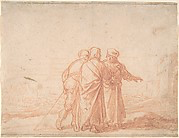
Today, I’ve been vexed by a small passage in Luke 24. Two people, one named Cleopas, were heading to Emmaus from Jerusalem, despondent, probably trudging. Jesus appears and walks alongside, hidden from them for the time, asking about what they are talking about. He listens, giving space and time for their grief. But, there’s a sudden turn:
He said to them, “How foolish you are, and how slow to believe all that the prophets have spoken! Did not the Messiah have to suffer these things and then enter his glory?” – Luke 24:25-26 NIV
This seems to be harsh, even unloving. But, digging down, foolish is probably a harder word than Jesus used – the Greek word anoetoi is closer to “unperceiving” than “stupid.” It’s not “you’re idiots.” It’s “you’re not seeing what’s right in front of you, and you have everything you need to see it.”
They had all the information — they even know about the empty tomb and the angels’ report (Luke 24:22-24). They just can’t assemble it into meaning. They’re not ignorant. They’re grief-stuck. The data is all there and they can’t see it because their framework for what the Messiah was supposed to do has collapsed.
Notice what Jesus does right after — he doesn’t lecture them for being slow. He walks them through the whole narrative, Moses through the prophets, and lets the story do the work. He doesn’t say “I’m the Messiah, you fools.” He shows them the shape of the story and lets them arrive at recognition on their own. Which they do — but not until Emmaus, at the table, in the breaking of bread. The head knowledge from the road wasn’t enough. It took embodied encounter.
Jesus didn’t mince words, didn’t back away from the confrontation, but lands a sharp word with grace afterwards. In other words, Jesus listened, gave a rebuke, then showed truth. Discovery, definition, and agency on a walk to a small town.
My experience also shows that wounds can be inflicted when the larger healing of the group is necessary.
During a Philmont trek, the crew had abandoned the Ranger-trained cooperative dish-washing system in favor of “everyone washes their own.” I found a dirty dish at camp and trash near the bear bags. At supper, I expressed direct anger about the lapse — not out of control, but clear and pointed. The crew was shaken. The Chaplain (one of the leadership positions of a crew) was incensed.
This even escalated to our feedback rounds later, where the Chaplain directly asked me about feedback that I had given about using the prescribed methods of cleaning, which I was glad to expound upon. This, as you may imagine, continued the feelings of anger (rage may be a better word).
But, after the feedback session, with everyone stewing, I patiently asked for Roses, Buds, and Thorns (giving more of an emotional tone from the day). The crew lit up, sharing stories of their Baldy summit: the difficulty of the climb, standing at the top, mini-bears that tried to steal their lunch, the pound cake they’d hauled up and wished they’d saved a piece. I ended the rounds with the Roses, in order to quell the hard feelings of confrontation.
The next morning, the Chaplain was navigator. Walking together on the trail, I asked a few questions of him, being the second in line: “Was I out of control last night?” No. “Can a servant leader express anger directly?” Yes, after thinking. “Did you see what I did with the Roses?” A look of recognition crept over the Chaplain’s face as he understood: healing can take place after the catharsis.
Servant leaders are unafraid of emotions that are hard, and sometimes deliver these emotions without fear. And, servant leaders don’t wound and leave, they wound and stay to heal afterwards.
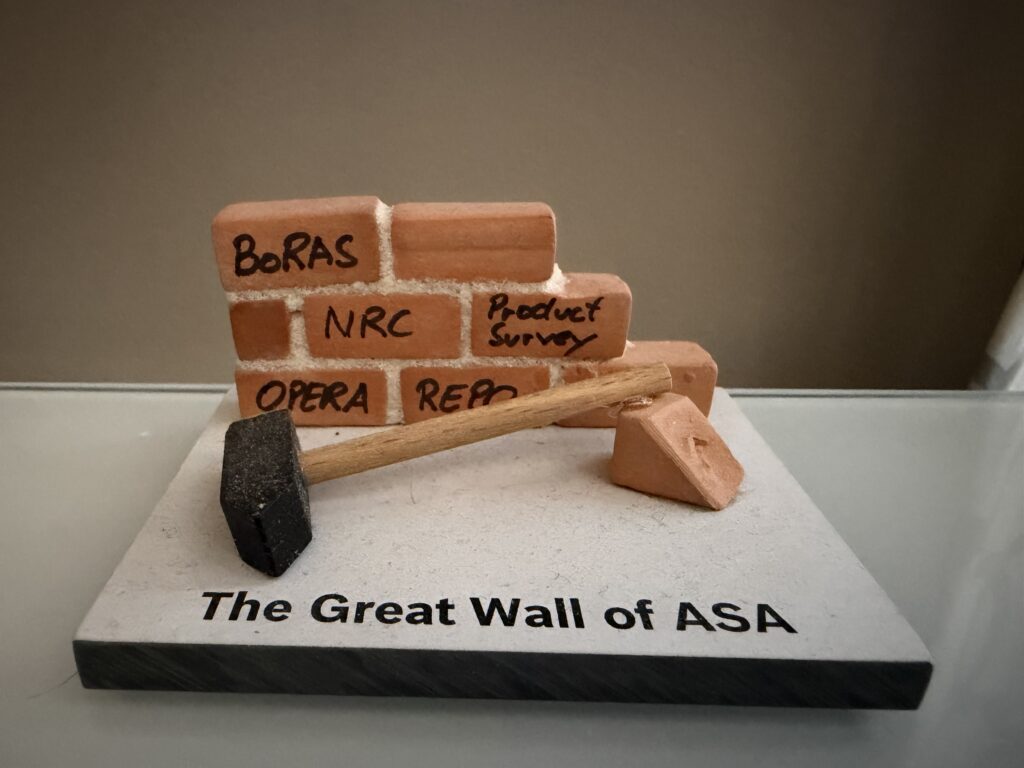
This morning, I am contemplating a small desk ornament, a testament of my time at Bosch. A time, where we shut down many small legacy systems, and spun up SAP to replace them.
This was a hard project – integrations are never easy, but ripping and replacing – this is difficult and painstaking work. Living in fear of regression – of users wanting their old systems back, we stuck to the task of building something new. The sledgehammer shown was insightful as a metaphor.
But, my reflection today is not the past; it is the present – a wall.
Servant leaders find walls all the time as they interact with others. Some walls are God-given, some are protecting wounds, some are just neutral space – but all are protecting something.
The temptation is to swing the sledgehammer, especially at walls we sense are hiding a wound. To get in, to fix, to force healing – isn’t this the way to help others?
To these motivations (which I am subject to as well), I raise one word – patience.
Sometimes, as a servant leader traces the boundary, an entrance emerges. This entrance may be small, may not even be seen easily, but certainly one left as the boundary was constructed.
And this is the place for the servant leader – not to smash in a weak place, but to softly knock. Softly knocking, as a request for attention, a gentle request, an invited entrance.
Jesus does this for us as well:
“Look! I stand at the door and knock. If you hear my voice and open the door, I will come in, and we will share a meal together as friends. – Revelation 3:20 NLT
Give the person you are serving the chance to see your patience, to invite you in, and to spend time within their boundary as a place of fellowship.
When searching for content about Servant Leadership, I’ve seen it in hundreds of LinkedIn posts, books about how to “effectively serve while leading”, even the BSA NYLT curriculum. This is a pseudo-form of Servant Leadership, and right now, I’m calling it what it really is:
It’s really “Others-First” Leadership.
It has many expressions:
“Others-First” leadership has motivation to help others, while secretly wanting to call back to itself, to use the language of service while remaining fundamentally self-oriented
“Others-first” leadership cloaks selfish ambition, hiding behind the tenets of holistic philosophy, taking a shortcut though the dark places of our soul
“Others-first” leadership only uses the principles that may help; only asking how to lead in a way that serves others
“Others-first” leadership is fundamentally about the leader being good at leading, of considering technique, optimization, and performance hacking the highest standard
What Was Lost
We’ve lost the inner orientation – the spiritual/philosophical/moral foundation that makes servant leadership more than just enlightened self-interest. We’ve lost the soul and power of how leaders fundamentally serve.
Witness the progression that happened in the last 50 years. Greenleaf discovers Servant-Leadership (although I would contend that he elucidates it). He builds a masterpiece of a library, of his talks and thoughts (although others would struggle to find organization in this chaotic struggle he faced). Spears picked this up, and developed 10 characteristics, giving more feet to how servant leaders really act and operate. Consultants and other marketers see a list, and know right away it can be packaged into bite-sized chunks, without the struggle that Greenleaf and Spears underwent. And, now we’re left with principles without the life-giving force that gives them power!
How to Recognize the Difference
Robert Greenleaf was clear about this:
Servant leadership is a philosophy and set of practices that enriches the lives of individuals, builds better organizations and ultimately creates a more just and caring world
We quickly and easily to move to “set of practices”, without considering the philosophy behind. These practices, while valuable, considerate, and helpful, come from the philosophy first and foremost – the deep well of decision to serve, to set your life aside, to consider others above yourself, to disappear in the flow.
Corruption or bypassing this philosophy is subtle, but striking when you see it. Take Spear’s 10 principles:
Listening – The “Others-First” leader listens to people because engaged people are productive, work harder, and express loyalty toward organizational goals. The Servant Leader listens because they believe that people have inherent worth and wisdom that deserves reverence, even when the listening gets hard.
Empathy – The “Others-First” leader understands the emotional states of those they lead just to help manage people effectively, building rapport that increases their influence, connecting to improve performance. The Servant Leader gives the person honor and understanding of their experience from within their frame of reference, placing themselves in that person’s position, walking in their shoes to respond to their wholeness as two image bearers of God.
Healing – The “Others-First” leader brings healing because healed people can feel oriented, and have a veneer of security and stability. Servant Leaders bring healing because brokenness is a condition of humanity, and this patient application of soul-change will allow the person to flourish
Awareness – The “Others-First” leader keeps a keen eye out for disturbances in the people they lead to head off potential issues later, and never turns the spotlight to their own soul. Servant Leaders bring awareness from themselves (inside-out) to others, uncovering their own awful truths, surfacing conflict, healing the wounds that revelations make.
Persuasion – The “Others-First” leader employs tactics to head toward agreement, even to the point of manipulation; it is really “command-and-control” in a friendly, smiling package. The Servant Leader employs humble openness, holding ideas and direction loosely, knowing that the best solution usually doesn’t reside with just one person.
Conceptualization – The “Others-First” leader sees what is best for themselves or the organization, and focuses their efforts to conform to this understanding (the very nature of “Human Resources”). The Servant Leader sees each person’s unique potential and dreams, believing organizational prosperity flows naturally from human flourishing rather than conformity to institutional objectives.
Foresight – The “Others-First” leader sees the future as potential risk, and takes steps to avoid failure, often papering over this frantic activity with documentation like risk registers. The Servant Leader embraces intuition, slows the emotional roll, applies their moral grounding, builds time into the decision, and feels settled in its application before building any documentation for the organization.
Stewardship – The “Others-First” leader manages resources and people effectively and competently, toward organizational effectiveness and waste minimization. The Servant Leader holds resources and people in sacred trust, knowing they are a temporary caretaker that is responsible to those served, future generations, and the God who provided them.
Growth – The “Others-First” leader embraces the person and equips them to be the best worker they can be (training, mentoring, even other development work) . The Servant Leader sees the person as a whole person, invests in their complete development, bringing out the best worker as a byproduct.
Community – The “Others-First” leader builds coalitions, with an improvement direction, even cohesiveness for all members (shared organizational goals, improved metrics). The Servant Leader creates genuine community where members serve the growth of each other, take unlimited liability for each other’s wellbeing, and willingly sacrifice personal advancement for communal flourishing.
Do you see the difference? Do you see the subtle corruption?
I’ve cloaked myself in powerless “others-first” leadership – it’s seductive, shows well on a CV, and makes you a marketable entity. Some of these blog posts, and LinkedIn content, upon further reflection, take this counterfeit stance. I’m declaring that this stops right now!
Hearing from the Founder
I’ve stood at Robert’s grave, looking at my own life, in the shadow of this giant, wondering if I will ever have the impact he did in his 86 years – impact that did not come from just going through the motions of identifying and promoting good principles.
I’ve stood at Robert’s grave, considering his claim to life – “Servant-Leader, Philosopher, Writer”. He didn’t start with what he did (philosophy, writing) – he started with his identity – Servant-Leader. An identity rooted in the wisdom of the ages – a deep understanding of taking up his cross, casting aside all grasping, and resting.
I’ve stood at Robert’s grave, looking and pondering the meaning of his epitaph: Potentially a good plumber, ruined by a sophisticated education. He’s calling us, in the humor of the philosopher, to something larger than ourselves. He’s sticking out his tongue at us; to not take ourselves too seriously, to jump into the flow of service and follow it to the place of impact.
The Call to Restoration
The call of Jesus is clear and unmistakeable; we must strap on the towel and wash the feet of those we serve, without any grasping of attention, or feeding our self-ambition. God will exalt us, just as He exalted Jesus:
Think of yourselves the way Christ Jesus thought of himself. He had equal status with God but didn’t think so much of himself that he had to cling to the advantages of that status no matter what. Not at all. When the time came, he set aside the privileges of deity and took on the status of a slave, became human! Having become human, he stayed human. It was an incredibly humbling process. He didn’t claim special privileges. Instead, he lived a selfless, obedient life and then died a selfless, obedient death—and the worst kind of death at that—a crucifixion.
Because of that obedience, God lifted him high and honored him far beyond anyone or anything, ever, so that all created beings in heaven and on earth—even those long ago dead and buried—will bow in worship before this Jesus Christ, and call out in praise that he is the Master of all, to the glorious honor of God the Father.
Often I’ve asked myself the question, “If a servant leader is focused on the group, and a difficult decision needs to be made, doesn’t this bring up a natural dichotomy?” Or, more to the point, isn’t a servant leader supposed to use gentle methods to foster healing and growth?
Wisdom from the Founder
Gentleness, in itself, is not always kindness. The act may seem hard and unreasonable to the recipient at the time, but it may be the most constructive kindness … The point is that seemingly harsh actions … produce a level of constructive tension in some cases without which it is unlikely that the individuals involved will surmount their own life problems
Robert K. Greenleaf, The Requirements of Responsibility
Robert correctly identifies the forcing of “constructive tension” into a person can honestly change the direction of their life.
While it would be easy to retreat into a simple analogy such as making children eat despised vegetables for their own health, there is a more profound element to a servant leader’s dilemma – the exercise of foresight.
Included in all of us — areas where we haven’t considered, general biases from past experiences, latent unhelpful ways, direct challenges — these all move toward spots in which we either ignorantly or willfully press on. Outside views, wisely accepted, can countervail and move us past these gaps. Finding solid servant leaders, giving them license to advise, allows us to move past or accelerate over these blocks.
Sometimes you even make enemies
However, sometimes as a servant leader, we are forced to intervene in situations where we are not invited. This corrective stance, though skillfully deployed, has the potential to hurt feelings and damage relationships.
It is deeply disappointing to the servant leader when these come about, and no amount of reflection can assuage the guilt inherent.
However, wisdom from Proverbs intervenes, putting us back on the balance:
Intentional wounding, with the counterbalance of healing, defines the activity of servant leadership; those without the fortitude will only compliment.
Summing it Up
Using all the skills of Servant Leadership (including Listening and Empathy), and focusing on the growth of the person will allow these tough decisions to be made, conceptualizing a future in which the person can move forward, unencumbered and free.
A recent conversation with a friend and colleague (Hi Steve!) got me thinking about roles as applied to servant leadership. Specifically, that some positional roles given to the leader are at best under tension, and sometimes in opposition to each other.
Multiple hats aren’t only a business problem
Of course, I have a song running through my head as I think this through – Amy Grant’s Hats, where she describes the tension of her life roles as a mother, a wife, and a worker:
It don’t stop No, it’s never gonna stop Why do I have to wear so many things on my head? Hats!
…
All because I’m driven
To be the very best for you
Roles in Conflict
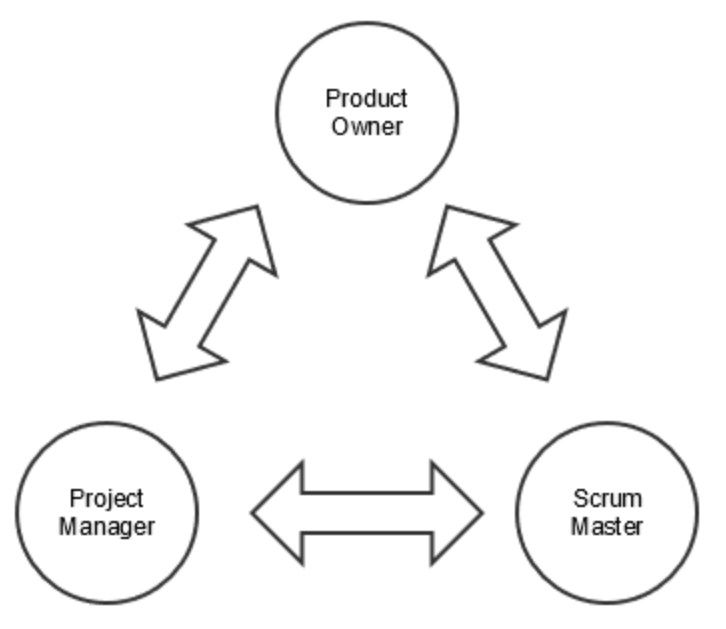
The specific example that Steve and I engaged was a set of roles we have defined in Agile Project Management. At our work, we define three roles:
Product Owner
Responsible for maximizing the value of the product and who is ultimately responsible and accountable for the end product that is built.
Scrum Master
The servant-leader of the team who keeps track of user stories, plans sprints, and manages the backlog. Escalates issues to both the Project Manager and the Project Owner
Project Manager
Assigned by the Project Owner; responsible for achieving the project objectives. Manages according to time and budget.
In a graphical form, this sets up a three-way balance; a natural pushing, pulling, and reporting structure:
In a triangle, finding a balance point involves either direct experimentation, or a whole lot of math, since the point in which all are in balance is a function of relative weights. It isn’t like a scale, which balances two points. As you can see from the above diagram, achieving balance in this structure by positions can also be challenging.
In reality, the balance resolves itself in the project manager lending weight to the lighter side by supporting (or assuming) one of the two other roles because of missing elements in the project; either the product owner is not available for frequent consultation, or the scrum master need additional support. As such, a good project manager can bolster whichever axis requires attention.
Servant Leader as Multiple-Hats
This brings up the fundamental tension – why can a good project manager shift and slide roles for ultimate project capability?
My simple postulation is that a good project manager is a servant leader. They are not defined by the role given, but are defined by the higher elements of listening, empathy, healing, and awareness, using persuasion, conceptualization, and foresight to bring about growth and community through stewardship. In this way, they are not calling attention to themselves (hierarchical authority), but are instead working behind the scenes for the fundamental progress of the project.
I think this has broader implications for all servant leaders. Because of this ability to focus on the group as the highest goal, they can keep more than one role, more than one idea in their head, navigating the cognitive dissonance as a liminal hotspot without resolving it further.
Lesson from Paul
Paul, as a sent-one (or apostle) of Jesus had one goal – transformation of people into a relationship with Jesus. In this, he took on the role of a servant as well, even defining what this means:
Even though I am free of the demands and expectations of everyone, I have voluntarily become a servant to any and all in order to reach a wide range of people: religious, nonreligious, meticulous moralists, loose-living immoralists, the defeated, the demoralized—whoever. I didn’t take on their way of life. I kept my bearings in Christ—but I entered their world and tried to experience things from their point of view. I’ve become just about every sort of servant there is in my attempts to lead those I meet into a God-saved life. I did all this because of the Message. I didn’t just want to talk about it; I wanted to be in on it!
I love how he expresses the fact that, although he didn’t take on the lifestyle of those he was serving, he engaged them in their own world on their terms – just as Jesus did. Separating himself and requiring others to meet his high standard, he would have not had the impact that this servant-leader life enables.
Summing it up
Multiple hats are a fact of life, and navigating them is best done with a higher goal in mind. Since servant leaders already have the higher goal of group development baked in, they can easily move between the roles.
As I continue on my journey toward servant leadership, I have often wondered about how to feel about my impact. In the dark of night, I sometimes struggle with these questions:
What is the value I bring to those I am leading?
Are their lives changing for the better?
Is there lasting value in my effort?
Does my leadership matter?
The founder’s tension
I know that Robert Greenleaf struggled with this question as well – his epitaph speaks volumes:
(in case the bottom is hard to read: “Potentially a good plumber, ruined by a sophisticated education”)
At the end of the day, plumbers can look back on a job well done, even point to the work accomplished. There is a satisfying finality, a recognized completeness to the labor.
Those of us tasked with leadership our impact is people, organizations, even communities. Sometimes there is an end task of our responsibility (i.e. a project, a key-performance indicator, a product, a vision) – but we are to help others achieve the task (otherwise we are not leading). The work is ongoing, and the results are intangible – sometimes even frustratingly elusive.
The founder’s proposal
So, how did Greenleaf resolve this tension, this internal anxiety? He proposed a framework of group assessment – acknowledging its problematic analysis:
The best test [of a servant leader], and difficult to administer, is: Do those served grow as persons? Do they, while being served, become healthier, wiser, freer, more autonomous, more likely themselves to become servants? And, what is the effect on the least privileged in society? Will they benefit or at least not be further deprived?
Robert K Greenleaf, The Servant as Leader
Greenleaf, in his economy of words, speaks volumes. In this short quote, he defines a number of elements that bear expansion:
Growth – Do those served grow as individuals, personally as well as professionally? The growth of followers is a distinctive feature of servant leadership.
Health – Are those served healthier, transformed into whole people. The active pursuit of healing forms the basis of the changes a leader brings to those being served
Wisdom – Do those served gain greater experience, knowledge, and good judgment while being served? Do they exhibit conceptualization and foresight in their own decisions?
Freedom – Are those served freer, both from their own blocks and inhibitions, and the external barriers placed on them?
Autonomy – Do those served have more control over their own decisions and lives? Are they empowered (and feel it)?
Leader continuation – Are followers being transformed into servant leaders? Replicating servant leadership in others is a profoundly satisfying result for a servant leader.
Common good – As a result of servant leadership, is society better off? Is community being built? Greenleaf suggests that servant leaders should seek out stakeholders that come from many different perspectives and lead with an eye on developing our impacted areas.
Using it it real life
I try to look at my impact using these hallmarks as a baseline to determine my impact, and assuage my questions. While Robert found it “difficult to administer”, I find that a patient, introspective assessment at how the group is doing according to these elements is important for my awareness; to find satisfaction in accomplishment or areas to improve (most often simultaneously).
Because we have isolated ourselves into larger, more anonymous living settings, our sense of independence hampers us from experiencing community – one that we are responsible to, and gain benefit from, and feel a place within.
As individuals are encouraged in growth, and some become servant leaders themselves, the servant leader turns toward building cohesiveness for mutual benefit to all group members. This is like a flywheel, in that the group starts feeding itself, and even turns to spread out in the community.
This mutual serving each other is a powerful hedge against the isolation we drift towards. And, as we bond together for a common cause, we add to the serving posture, and make impacts both external, and internal to ourselves and the group.
Creating community in Institutions
The servant leader senses that much has been lost in recent human history as a result of the shift from local communities to large institutions as the primary shaper of human lives. This awareness causes the servant leader to seek to identify some means for building community among those who work within a given institution. Servant leadership suggests that true community can be created among those who work in businesses and other institutions.
It is possible to create community within an organization, even a business; much like servant leaders can build groups in any context, servant leaders can leverage groups into community.
I’ve had the privilege of building one community in my business setting, formed to handle breakdowns in satisfaction among people in our organization. From the forming stages of complaining, they now have turned into a problem-solving group. The satisfaction of seeing individual growth and healing has more than outweighed the effort required. This deserves a post later See the narrative here.
Servant Leaders as Focusers
Greenleaf (1977/2002) said: All that is needed to rebuild community as a viable life form for large numbers of people is for enough servant-leaders to show the way, not by mass movements, but by each servant-leader demonstrating his or her unlimited liability for a quite specific community-related group.
Servant leaders who focus on one specific problem, disturbed by their awareness of a broken area, become a powerful lever as they gather those around that also feel the brokenness. For instance, think about these servant leaders, and the brokenness they coalesced others around – making lasting change for community healing:
Martin Luther King, Jr. – Leader of the Civil Rights movement
Nelson Mandela – Equality in apartheid (segregated) South Africa
Mahatma Gandhi – Opposing colonial rule in India
Mother Teresa – Served people who were dying of HIV/AIDS, leprosy and tuberculosis in Calcutta, India
Laying Down Your Life
Jesus spoke of this way of servanthood – specifically to love one another. This love required sacrifice; the intentional setting-aside of yourself for those that you are serving:
“I’ve told you these things for a purpose: that my joy might be your joy, and your joy wholly mature. This is my command: Love one another the way I loved you. This is the very best way to love. Put your life on the line for your friends. You are my friends when you do the things I command you. I’m no longer calling you servants because servants don’t understand what their master is thinking and planning. No, I’ve named you friends because I’ve let you in on everything I’ve heard from the Father.
Servant leaders believe that people have a value beyond being just workers. Servant leaders are deeply committed to the growth of each and every individual.
Servant leaders are people focused, desiring the best for them as individuals. Never settling for status quo, the servant leader uses listening, empathy, healing, and awareness to understand where the person currently is, conceptualizing a new vision for the served person, and persuading them to own this vision – helping them to make plans and set goals toward those plans (the essence of foresight). It truly represents a capstone of the principles, taking the skills of the servant leader and applying them directly.
The ultimate test, represents the best test from Greenleaf: does the individual grow as a person. As such, it is hardest to measure, since the served person also influences the result, taking all the praises.
Of course, the servant leader must identify motivation in the individual, even if it buried or latent. Without this small ember, which the leader can fan, no amount of principle application can burst flames. Selection of a served individual therefore takes wisdom, as we all contend with limited resources.
Growth in the business context
Servant leaders believe that people have an intrinsic value beyond their tangible contributions as workers. As such, the servant leader is deeply committed to the growth of each and every individual within his or her organization. The servant leader recognizes the tremendous responsibility to do everything in his or her power to nurture the personal and professional growth of employees and colleagues. In practice, this can include (but is not limited to) concrete actions such as making funds available for personal and professional development, taking a personal interest in the ideas and suggestions from everyone, encouraging worker involvement in decision-making, and actively assisting laid-off employees to find other positions
In this context, we all know areas where it is bad to mix personal with business. A small list of areas that are commonly cited as cautions:
Leads to poor business decisions
Business decisions are complicated with“emotional baggage”
The motive of personal gain overrides the achievement of business objectives
However, dividing up our lives into separate contexts is difficult, and sometimes impossible. Different spheres of our lives intersect; bringing a whole person into workplace is a long-term strategy. We need personal attributes of individuals to propel business forward:
Solid listening skills
Good speaking ability
Empathetic handling of problems
Significant ethical motivation
Maturity and temperate handling
We therefore, as business servant leaders, need to focus on the whole person. Aligning with our business objectives, giving opportunity to grow as described above, and developing all spheres of the individual, we can built the platform needed for these individuals to take their place as whole-person workers who feel significant, challenged, and motivated.
Legacy
In the quiet hours of the mind, even heading off into the twilight of life, influence is gathered from those individuals we have poured our energy into, especially ones that have succeeded beyond our conceptualized vision. “Good work!” is a satisfying statement from not only the ones we have served, but to our Master who called us into this humble way of seeing our world:
“Are you tired? Worn out? Burned out on religion? Come to me. Get away with me and you’ll recover your life. I’ll show you how to take a real rest. Walk with me and work with me—watch how I do it. Learn the unforced rhythms of grace. I won’t lay anything heavy or ill-fitting on you. Keep company with me and you’ll learn to live freely and lightly.”