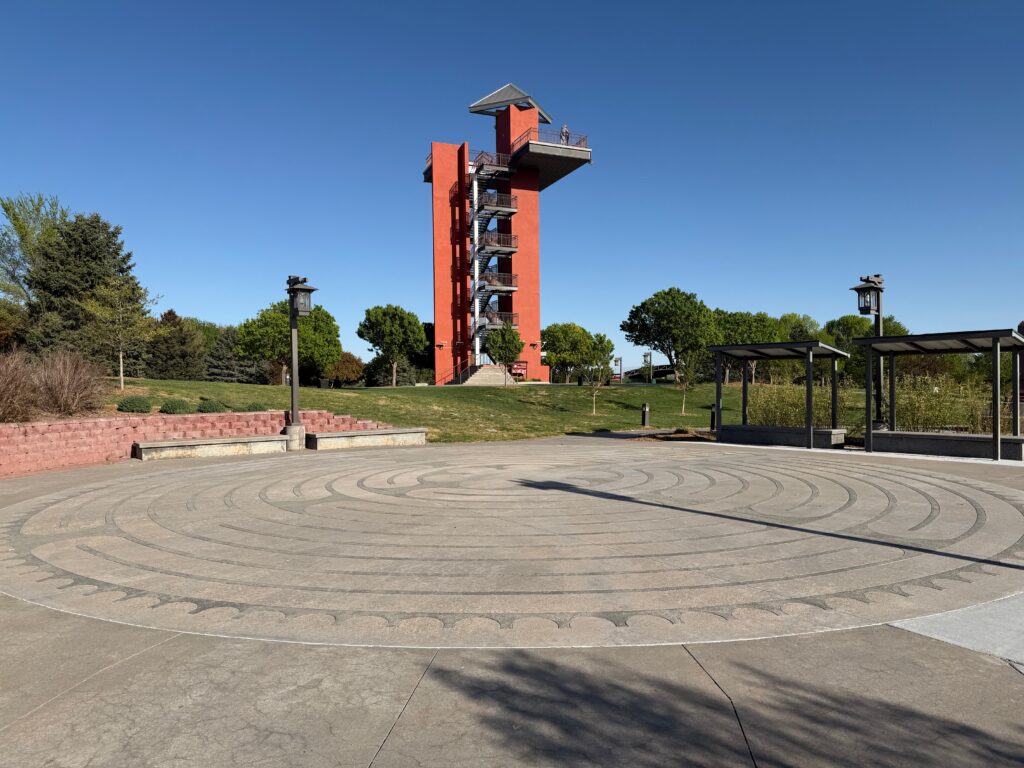
(Foreground, Chartres Cathedral Labyrinth, background Gottschalk Tower, in Yanney Heritage Park, Kearney, NE)
This photo came up in my highlights today, and has me musing on the idea of boundaries.
Both have been traced, both have significant value to one who understands the disciplines inherent in each.
The tower discipline is clear; moving outside its boundaries equates to injury. Elevation is the key, and the reward is significant at the end.
The labyrinth discipline is invisible; it can be walked straight across with no effort. Mindfulness is the key, and the reward given is internal, defined by the person engaging.
Servant leaders have both of these in our lives. Yes, we sometimes need to pull others from the brink when physical harm is imminent. But the labyrinth speaks to the internal, the tracing, the way of limiting yourself to a boundary largely defined internally.
The fulness of the labyrinth is in the use of space, the long path, the discipline to stay in the lane. The walk is not arduous, and quells the physical side of the mind, allowing other areas to unlock and express. Satisfaction is not derived from finishing, but from the journey; frustratingly close to the center at times, knowing the path has more bends before accomplishment.
People are like this as well; conceptualization and foresight bring us the vision of where the group or individual would be best landed. Sometimes these are almost tangible, within reach, only to be shifted to a new area which seems to take us away from the goal. It is patient work to continue the path, knowing a few short steps would take us into this area, but we have many more linear steps to take to stay in the boundary.
For this, I pose an aphorism – “Don’t fear, veer, or steer”. All three are us taking the control, wresting the direction from those led. All will produce outcomes that will reflect on the skill of the leader
But, the outcome of the Best Test: “Do they, while being served, become healthier, wiser, freer, more autonomous, more likely themselves to become servants?” stays our hand, focuses on the individual or group, and leads us to stay in the boundary. The end result is growth, not of the leader, but those served.