I’ve engaged with a number of other management philosophies, and they seem to come down to a set of criteria that define good management skills. For instance, from Indeed – 5 Essential Management Skills:
Leadership – including skills such as decisiveness, team building, empathy, conflict management, and motivating others
Planning – including vision, critical thinking, flexibility, and problem-solving skills
Strategy – including creativity, conflict resolution, and problem-solving
Communication – including listening, negotiation, persuasion, building relationships, teamwork
Organization – including goal setting, project management, time management, and scheduling
You can certainly notice that some of the Servant Leader principles already show up directly. Indirectly, there are many more we can check off – vision is covered by conceptualization, for example.
However, Robert Greenleaf probably said this best, in the economic way he defines:
It is the ability to state a goal and reach it, through the efforts of other people, and satisfy those whose judgement one respects, under conditions of stress.
Robert Greenleaf, Something to Hope For
Further in the Indeed article, you get an appreciation of how to build these skills, which I would say is a tripartite approach – test yourself by doing, appeal to others by mentoring, and gain feedback by asking others (I would say that this is valuable from many levels, including those being led).
A Servant Leader uses the skills of awareness and listening, along with the conscious choice to lead in pursuit of building these other management skills, knowing all along that those being led are of higher significance, and success is only measurable by their achievement1; at the heart is only the desire to serve2.
A recent conversation with a friend and colleague (Hi Steve!) got me thinking about roles as applied to servant leadership. Specifically, that some positional roles given to the leader are at best under tension, and sometimes in opposition to each other.
Multiple hats aren’t only a business problem
Of course, I have a song running through my head as I think this through – Amy Grant’s Hats, where she describes the tension of her life roles as a mother, a wife, and a worker:
It don’t stop No, it’s never gonna stop Why do I have to wear so many things on my head? Hats!
…
All because I’m driven
To be the very best for you
Roles in Conflict
The specific example that Steve and I engaged was a set of roles we have defined in Agile Project Management. At our work, we define three roles:
Product Owner
Responsible for maximizing the value of the product and who is ultimately responsible and accountable for the end product that is built.
Scrum Master
The servant-leader of the team who keeps track of user stories, plans sprints, and manages the backlog. Escalates issues to both the Project Manager and the Project Owner
Project Manager
Assigned by the Project Owner; responsible for achieving the project objectives. Manages according to time and budget.
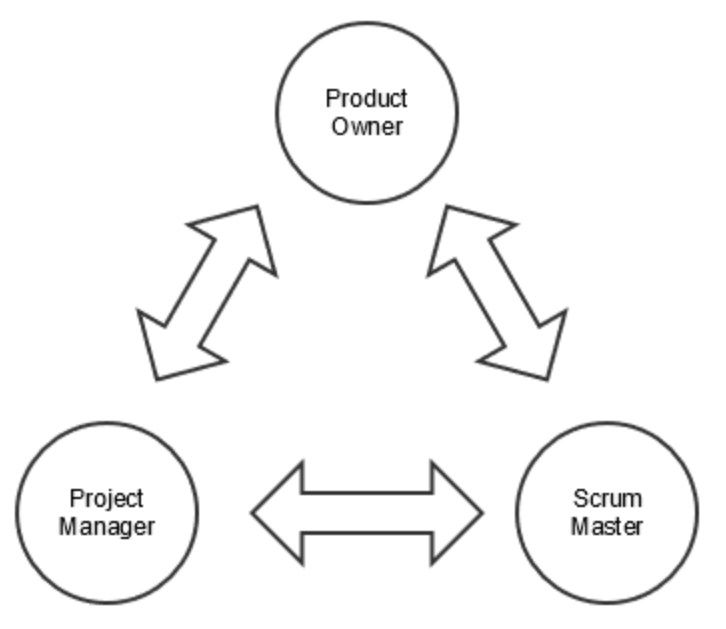
In a graphical form, this sets up a three-way balance; a natural pushing, pulling, and reporting structure:
In a triangle, finding a balance point involves either direct experimentation, or a whole lot of math, since the point in which all are in balance is a function of relative weights. It isn’t like a scale, which balances two points. As you can see from the above diagram, achieving balance in this structure by positions can also be challenging.
In reality, the balance resolves itself in the project manager lending weight to the lighter side by supporting (or assuming) one of the two other roles because of missing elements in the project; either the product owner is not available for frequent consultation, or the scrum master need additional support. As such, a good project manager can bolster whichever axis requires attention.
Servant Leader as Multiple-Hats
This brings up the fundamental tension – why can a good project manager shift and slide roles for ultimate project capability?
My simple postulation is that a good project manager is a servant leader. They are not defined by the role given, but are defined by the higher elements of listening, empathy, healing, and awareness, using persuasion, conceptualization, and foresight to bring about growth and community through stewardship. In this way, they are not calling attention to themselves (hierarchical authority), but are instead working behind the scenes for the fundamental progress of the project.
I think this has broader implications for all servant leaders. Because of this ability to focus on the group as the highest goal, they can keep more than one role, more than one idea in their head, navigating the cognitive dissonance as a liminal hotspot without resolving it further.
Lesson from Paul
Paul, as a sent-one (or apostle) of Jesus had one goal – transformation of people into a relationship with Jesus. In this, he took on the role of a servant as well, even defining what this means:
Even though I am free of the demands and expectations of everyone, I have voluntarily become a servant to any and all in order to reach a wide range of people: religious, nonreligious, meticulous moralists, loose-living immoralists, the defeated, the demoralized—whoever. I didn’t take on their way of life. I kept my bearings in Christ—but I entered their world and tried to experience things from their point of view. I’ve become just about every sort of servant there is in my attempts to lead those I meet into a God-saved life. I did all this because of the Message. I didn’t just want to talk about it; I wanted to be in on it!
I love how he expresses the fact that, although he didn’t take on the lifestyle of those he was serving, he engaged them in their own world on their terms – just as Jesus did. Separating himself and requiring others to meet his high standard, he would have not had the impact that this servant-leader life enables.
Summing it up
Multiple hats are a fact of life, and navigating them is best done with a higher goal in mind. Since servant leaders already have the higher goal of group development baked in, they can easily move between the roles.
Because we have isolated ourselves into larger, more anonymous living settings, our sense of independence hampers us from experiencing community – one that we are responsible to, and gain benefit from, and feel a place within.
As individuals are encouraged in growth, and some become servant leaders themselves, the servant leader turns toward building cohesiveness for mutual benefit to all group members. This is like a flywheel, in that the group starts feeding itself, and even turns to spread out in the community.
This mutual serving each other is a powerful hedge against the isolation we drift towards. And, as we bond together for a common cause, we add to the serving posture, and make impacts both external, and internal to ourselves and the group.
Creating community in Institutions
The servant leader senses that much has been lost in recent human history as a result of the shift from local communities to large institutions as the primary shaper of human lives. This awareness causes the servant leader to seek to identify some means for building community among those who work within a given institution. Servant leadership suggests that true community can be created among those who work in businesses and other institutions.
It is possible to create community within an organization, even a business; much like servant leaders can build groups in any context, servant leaders can leverage groups into community.
I’ve had the privilege of building one community in my business setting, formed to handle breakdowns in satisfaction among people in our organization. From the forming stages of complaining, they now have turned into a problem-solving group. The satisfaction of seeing individual growth and healing has more than outweighed the effort required. This deserves a post later See the narrative here.
Servant Leaders as Focusers
Greenleaf (1977/2002) said: All that is needed to rebuild community as a viable life form for large numbers of people is for enough servant-leaders to show the way, not by mass movements, but by each servant-leader demonstrating his or her unlimited liability for a quite specific community-related group.
Servant leaders who focus on one specific problem, disturbed by their awareness of a broken area, become a powerful lever as they gather those around that also feel the brokenness. For instance, think about these servant leaders, and the brokenness they coalesced others around – making lasting change for community healing:
Martin Luther King, Jr. – Leader of the Civil Rights movement
Nelson Mandela – Equality in apartheid (segregated) South Africa
Mahatma Gandhi – Opposing colonial rule in India
Mother Teresa – Served people who were dying of HIV/AIDS, leprosy and tuberculosis in Calcutta, India
Laying Down Your Life
Jesus spoke of this way of servanthood – specifically to love one another. This love required sacrifice; the intentional setting-aside of yourself for those that you are serving:
“I’ve told you these things for a purpose: that my joy might be your joy, and your joy wholly mature. This is my command: Love one another the way I loved you. This is the very best way to love. Put your life on the line for your friends. You are my friends when you do the things I command you. I’m no longer calling you servants because servants don’t understand what their master is thinking and planning. No, I’ve named you friends because I’ve let you in on everything I’ve heard from the Father.
Servant leaders believe that people have a value beyond being just workers. Servant leaders are deeply committed to the growth of each and every individual.
Servant leaders are people focused, desiring the best for them as individuals. Never settling for status quo, the servant leader uses listening, empathy, healing, and awareness to understand where the person currently is, conceptualizing a new vision for the served person, and persuading them to own this vision – helping them to make plans and set goals toward those plans (the essence of foresight). It truly represents a capstone of the principles, taking the skills of the servant leader and applying them directly.
The ultimate test, represents the best test from Greenleaf: does the individual grow as a person. As such, it is hardest to measure, since the served person also influences the result, taking all the praises.
Of course, the servant leader must identify motivation in the individual, even if it buried or latent. Without this small ember, which the leader can fan, no amount of principle application can burst flames. Selection of a served individual therefore takes wisdom, as we all contend with limited resources.
Growth in the business context
Servant leaders believe that people have an intrinsic value beyond their tangible contributions as workers. As such, the servant leader is deeply committed to the growth of each and every individual within his or her organization. The servant leader recognizes the tremendous responsibility to do everything in his or her power to nurture the personal and professional growth of employees and colleagues. In practice, this can include (but is not limited to) concrete actions such as making funds available for personal and professional development, taking a personal interest in the ideas and suggestions from everyone, encouraging worker involvement in decision-making, and actively assisting laid-off employees to find other positions
In this context, we all know areas where it is bad to mix personal with business. A small list of areas that are commonly cited as cautions:
Leads to poor business decisions
Business decisions are complicated with“emotional baggage”
The motive of personal gain overrides the achievement of business objectives
However, dividing up our lives into separate contexts is difficult, and sometimes impossible. Different spheres of our lives intersect; bringing a whole person into workplace is a long-term strategy. We need personal attributes of individuals to propel business forward:
Solid listening skills
Good speaking ability
Empathetic handling of problems
Significant ethical motivation
Maturity and temperate handling
We therefore, as business servant leaders, need to focus on the whole person. Aligning with our business objectives, giving opportunity to grow as described above, and developing all spheres of the individual, we can built the platform needed for these individuals to take their place as whole-person workers who feel significant, challenged, and motivated.
Legacy
In the quiet hours of the mind, even heading off into the twilight of life, influence is gathered from those individuals we have poured our energy into, especially ones that have succeeded beyond our conceptualized vision. “Good work!” is a satisfying statement from not only the ones we have served, but to our Master who called us into this humble way of seeing our world:
“Are you tired? Worn out? Burned out on religion? Come to me. Get away with me and you’ll recover your life. I’ll show you how to take a real rest. Walk with me and work with me—watch how I do it. Learn the unforced rhythms of grace. I won’t lay anything heavy or ill-fitting on you. Keep company with me and you’ll learn to live freely and lightly.”
We are all given a sphere to manage, an area of responsibility, a place for impact. Some of it is chosen, some of it comes by position, and some by necessity. All of these, however are entrusted to us to look after.
Entrusted is a special word – I think of it as transferring an object of value from the owner, who never relinquishes ownership, to one that has to protect and care for this value. I also think this is a time-based concept, in that there is a beginning (the delegation), and an ending (the eventual return).
Two real-life examples of entrust
Children are a family’s form of entrust; they are never completely owned by parents, yet they are protected, cared for, guided, and yes, even managed by parents. While under our care, we hold a high responsibility to develop them into adults of character and competence. Once adulthood is reached, we hand off their development as a return of their independence.
Money is another area entrusted to us, as it seems we never own it, as much as we would like. While under our care, we are to manage it, to use it, and allow some to grow. Eventually, we all must return money to others, even at our life’s demise.
Entrusted to Stewardship
Stewardship is the way we carry out this entrust; it focuses on the fact that we aren’t the owner – merely the one responsible. Servant leaders are conspicuously aware that they don’t exercise control, rather they exercise influence:
Servant leadership, like stewardship, assumes first and foremost a commitment to serving the needs of others. It also emphasizes the use of openness and persuasion, rather than control.
Jesus taught many truths in parable format (using pictures and then-known examples, like agriculture).
In this way, Jesus told a parable (in Matthew 25:14-30) about a rich person giving money to his servants, and leaving on an extended trip – with the implied expectation to do something with it. Even the assignment was customized to the ability of the servant – some received more than others.
One servant was given $5,000 to work with, and the parable said he went to work and doubled the investment.
Eventually, a reckoning happens:
““After a long absence, the master of those three servants came back and settled up with them. The one given five thousand dollars showed him how he had doubled his investment. His master commended him: ‘Good work! You did your job well. From now on be my partner.’”
As you can see, being faithful to multiply the investment (as in taking risks, watching over, and developing) led into an even greater role with the master.
However, those who want to keep to themselves, to hoard their energy and effort, also have an example in this parable. One of the servants just buried the smallest sum, and returned it to the penny to the master. To say the master was furious, well…:
“‘Take the thousand and give it to the one who risked the most. And get rid of this “play-it-safe” who won’t go out on a limb. Throw him out into utter darkness.’
We are called to take this gift we are given to serve, and do something with it. This is the entrust given to us, and it is up to us to steward it.
Summing it up
Servant leader uses stewardship entrusted to us, to persuade others through awareness and empathy to go well beyond, and build on the investment given to us. It is a high calling, one that will require us to take risks (conceptualization mitigated through foresight), knowing that we answer to one higher than us.
Foresight enables servant leaders to understand lessons from the past and the present. These lessons help them understand the consequences of decisions in the future.
Like a good farmer, a servant leader has a good sense of impact. Actions or decisions that are seemingly inconsequential may have significant value over time, and identification of these inflection points are crucial for any leadership. As this is not always apparent at the immediate time, it takes awareness combined with wisdom to see past and future.
This becomes almost esoteric in application, and indeed, sometimes it’s a mystery to know, even personally, whether a decision is right:
Closely related to conceptualization, the ability to foresee the likely outcome of a situation is hard to define, but easier to identify. One knows foresight when one experiences it. Foresight is a characteristic that enables the servant leader to understand the lessons from the past, the realities of the present, and the likely consequence of a decision for the future. It is also deeply rooted within the intuitive mind.
Without a moral standard, intuition can be led astray. It forms the bedrock of the decision, the guardrails around the correct road, the limits necessary.
As I’ve previously posted, my moral grounding starts with my relationship with Jesus, I look to Him for examples during His life on earth:
A religion scholar tried to trip Jesus up by prioritizing the commandments God gave to the Jewish nation. In response, He gives the bedrock of these commandments:
Jesus said, “‘Love the Lord your God with all your passion and prayer and intelligence.’ This is the most important, the first on any list. But there is a second to set alongside it: ‘Love others as well as you love yourself.’ These two commands are pegs; everything in God’s Law and the Prophets hangs from them.”
The second parallel commandment, loving others as yourself, is inherent in servant leadership. As a good first pass of a decision, caring for others is a great start.
Embracing Intuion
Often after this first pass of caring for others as a high goal, there are many paths to take, and not all of them are clear. Here is my list of habits I use to build on my foundation:
Take a deep breath – Many times a decision needs a bit of consideration, and using your breathing to clear the decks and slow the emotional roll.
Allow yourself some time – While many decisions need immediate attention, some may need more consideration; don’t be afraid to ask for more time.
Test the decision – Throwing the alternatives at your target to see if it will stand up to the test – even ones that initially seem better. Take a look at the goals and outcomes of each branch
Being able to describe the decision in pictures or analogies – I find that if I can describe the decision in visual or other ways, it clarifies the decision and allows me to describe it to others.
Feeling settled in the decision – it’s hard to describe, but when I find a decision is right, there’s a deep-seated satisfaction with the future outcome that is peaceful, even if not easy.
Putting it together
Foresight is a somewhat mysterious concept. Having a bedrock set of morals, along with using wisdom and intuition, you are able to synthesize good decisions that will stand the tests that will come as you lead.
Most people get caught up into the present, the urgent, the fire waiting as you engage the group. Yet, the value of many leaders is to build on a larger base, to bring the best to reality.
Servant leaders seek to nurture their abilities to dream great dreams. The ability to look at a problem or an organization from a conceptualizing perspective means that one must think beyond day-to-day realities. For many leaders, this is a characteristic that requires discipline and practice. The traditional leader is consumed by the need to achieve short-term operational goals. The leader who wishes to also be a servant leader must stretch his or her thinking to encompass broader-based conceptual thinking. Servant leaders are called to seek a delicate balance between conceptual thinking and a day-to-day operational approach.
Conceptualization takes the external awareness principle and the listening principle, synthesizes the best from each, and places this vision in front of the group using persuasion.
I have found it best to take the time to reflect, to pause, or as Larry states, to engage discipline and practice to see past the immediate problems toward a good future solution. However, I have also presented a concept far beyond what the group is ready to engage, and found that patience is necessary to realize the goal – it becomes an indicator to me to step more into the operational aspects so I don’t get too “pie in the sky”. Balancing this tension is an important discipline of the servant leader.
Persuasion, defined as a drawing toward, or pushing toward a goal, is the first element in our principles that highlights the leader functions of the servant leader. All others (listening, empathy, healing, awareness) fall more over to the servant side of the balance.
Traditional leadership methods generally work from a top-down power flow, allowing this type of leader to issue commands. This seems like an effective way to coordinate results, and it is a leadership style widely used.
Servant leaders, however, rarely reach for this style, choosing the harder work of bringing others along in a convincing way. Like a flywheel, it starts slowly, and builds momentum – momentum that continues long after force is applied.
The Primary Leading
Spears points out that this persuasion default is the primary difference between servant leaders and other authority models:
Another characteristic of servant leaders is reliance on persuasion, rather than on one’s positional authority, in making decisions within an organization. The servant leader seeks to convince others, rather than coerce compliance. This particular element offers one of the clearest distinctions between the traditional authoritarian model and that of servant leadership. The servant leader is effective at building consensus within groups.
Getting everyone aligned is a patient, sometimes grueling task. Very rarely does a group automatically line up , but I have been part of groups that do line up quickly, pointing at a servant leader who has been consistently and masterfully pursing this alignment. These servant leaders I see as giving a rudder pressure to the group; like an oil tanker turning, it takes turning the wheel and waiting to achieve results.
Leading from the Back
Like all disciplines in servant leadership, this is part of the humble shaping of the group. It never calls attention to the servant leader, and allows the group to own their destiny. There lies its power – when success is proven, all praise goes to the group.
At the end of the day, the servant leader has the grounding to know his influence is helping, healing, and building, allowing others to shine. It is a substantial leader that can support this without calling attention back – but worthy of pursuit!
Awareness is truly a difficult concept to understand in the servant leader role. It takes on two different facets:
The internal view of the servant leader (internal awareness)
Awareness of the brokenness, or the task that needs to be done (external awareness)
Let’s tackle each separately, then combine them into a set of behaviors and attitudes later.
Internal Awareness
General awareness, and especially self-awareness, strengthens the servant-leader. Awareness helps one in understanding issues involving ethics, power, and values. It lends itself to being able to view most situations from a more integrated, holistic position.
Awareness for the servant leader starts with an internal look, most often starting with the basic questions of life:
Who am I?
Why am I here?
Where am I going?
How will I get there?
What does success look like?
What are my morals, and where do I get them?
This is not to say that the servant leader has all the answers – rather that there is a continuing process of asking and answering them, of a movement between resolution and disturbance.
By having these basic questions in a semi-solid state, the servant leader can look out for more areas, detecting the gaps below the issues presented, to look beyond the face value. By exercising their questioning mindset frequently internally, it also sets up the servant leader to bring this mindset externally.
External Awareness
As Greenleaf (1977/2002) observed: “Awareness is not a giver of solace—it is just the opposite. It is a disturber and an awakener. Able leaders are usually sharply awake and reasonably disturbed. They are not seekers after solace. They have their own inner serenity”
Coming from the basis of settled/unsettled questions, the servant leader can expand past themselves into seeing the brokenness and gaps in the others; the people being served. This brings a desire to heal, and then to act – driving the discontent with current reality.
Many of the servant leaders I know have a keen observational way about them, like they have another, higher sense of what is happening. This comes from being able to listen with empathy, as they set aside themselves.
Sometimes this awareness points at the blindness of others, including blindness to their own impacts, deception, or other self-serving actions. This puts the servant leader in the mode of calling out uncomfortable truths . Servant leaders are not afraid of conflict, rather they use it to provoke movement toward healing.
Jesus using Awareness
In Matthew 16:13-28, Jesus leads the disciples, especially Peter, in a discussion of who Jesus really is. Upon Peter’s confession that Jesus is “the Christ, the Messiah, the Son of the living God”, Peter is commended, even told that he is a Rock. I imagine Peter feeling quite fulfilled by this, even a bit puffed up.
Next, though, Jesus describes how it is necessary to sacrifice Himself, die, and be raised on the third day. Peter, takes Jesus by the hand, protests, even saying, “Impossible, Master! That can never be!”
The next verse is quite telling, showing the way a servant leader can forcefully provoke awareness:
But Jesus didn’t swerve. “Peter, get out of my way. Satan, get lost. You have no idea how God works.”
I imagine Peter was swimming -first he is called a Rock, then he’s called Satan. Jesus, aware of Peter’s expectations, drives a wedge and a stake right through them. Peter’s desires were running contrary to the servant – the self-sacrificial posture required, even to suffering.
Putting Awareness together
Identifying the issues and bringing them into sharp relief is the point of awareness, even the internal awareness of the servant leader. It starts with a discontent, even a disturbance identified. Provoking themselves and others toward empathy and healing is rarely an easy task, but tools like keen observation and brave (even difficult) communication and needed and useful.
One of the great strengths of servant leadership is the potential for healing one’s self and others. Servant leaders help themselves and others feel better and be better
Healing is a natural result in the application of the two proceeding principles – #1 – Listening and #2 – Empathy. Between these skills, others start to feel valued as people, and move past their feelings of stuckness and the near constant looking for others to blame. They are freed up to envision something outside themselves, and head toward a future that is more appealing than their current state.
Receiving the Healing
The healing of relationships is a powerful force for transformation and integration. One of the great strengths of servant leadership is the potential for healing one’s self and one’s relationship to others. Many people have broken spirits and have suffered from a variety of emotional hurts. Although this is a part of being human, servant leaders recognize that they have an opportunity to help make whole those with whom they come in contact.
This relational “making right” is a near-constant outlook for the servant leader; opportunities will present themselves in ways sometimes least expected. Including yourself, as the servant leader, as the human condition is bent toward brokenness and pain. But, this hidden habit of moving past yourself, of taking on the burdens of others, allows you to experience the freedom from your own burden.
I have been part of teams in the past that suffered underneath broken leadership. It is truly difficult to help others realize that you are not “more of the same”, that you believe in them as people that matter, that you are willing to listen and act. Deep wounds require more time, but teams are thirsty for this kind of leadership. This work of healing takes small, patient steps to build the trust required for the next principles.
An Example from Jesus
In Luke 9, Jesus introduces the fact that he will be tried, convicted, killed, and raised on the third day. The first time He mentioned it in verse 22, He moved into a discussion of how they move into this servant life, even one of suffering.
But, they did not get the message.
The second time Jesus brings this up, the disciples not only missed it, but it was like they were hearing a foreign language. Especially when they started arguing about who would be best known. See how Jesus heals the infighting:
They started arguing over which of them would be most famous. When Jesus realized how much this mattered to them, he brought a child to his side. “Whoever accepts this child as if the child were me, accepts me,” he said. “And whoever accepts me, accepts the One who sent me. You become great by accepting, not asserting. Your spirit, not your size, makes the difference.”
There is nothing like being reminded that a child, with child-like faith, can be greater than you to give you pause in your prideful arrogance. Jesus reveals that the smaller, the more-open, the humble are closer to Him and God – what you do outside of this acceptance is valueless.
Summing it up
Healing involves the servant leader in patient, humble, listening steps to allow the thirsty team to build trust, to see themselves as valuable, and begin to realize their potential. The servant leader is also the recipient of this healing, as the outward focus allows healing internally too.