Servant Leadership in the next generation

Today, I had an opportunity to spend some time with our new NYLT leaders – youth that have taken the course, and now wish to lead the next one. It was a grand time of rekindling their friendships, to get to know each other, play games, and learn what the course requires.

I know that my ears pricked up when I heard the Senior Patrol Leader announce that they would be moving into the Servant Leader module, and I moved from being in the kitchen, to being with the youth.

The SPL spent some time describing the difference between top-down leadership, and bottom up leadership – all using a pyramid, with the leader at the apex – the lesson being that inverted pyramids are at the heart of the Scouting program, as supportive and helpful leaders are what we are developing.

However, the SPL was tripped up by the final quote, meant to be a discussion point:

[Servant leadership] begins with the natural feeling that one wants to serve, to serve first. Then conscious choice brings one to aspire to lead — Robert Greenleaf

He was confused by the economical and paradoxical way of Greenleaf; in fact, I asked him to read the quote a few times as words were missed and jumbled.

He then asked “What this quote means to you?” He received a few responses, some heading toward others-first leadership, some talking about wanting to serve — standard fare for the first time entering into the deep world of Servant Leadership.

As the group started to wind down, I couldn’t help but to put up my hand.

Acknowledged, I then moved into my understanding of this quote — the basic desire of us to serve one another (like listening and empathy and healing). Then, the choice, the recognition that leading others is the effective way of serving.

This didn’t compute, didn’t land with the youth. So, I doubled back and asked the question: why does everyone else want to lead? They were quick to respond — money, power, status — they’ve seen what the wider world has to offer. I then asked the question what if you wanted to serve others, to offer things to them that will improve their lives; they were on board, wanting to improve others. The ultimate question remained – what happens when you recognize that, by leading others, you multiply this service; and I saw the recognition start to dawn.

Pulling out the best test was next – Greenleaf’s formation of how to evaluate servant leaders: is the group getting better, growing stronger, becoming servant leaders themselves?

Now the quiet reigned as they saw not only the leader challenge, but the impact, the significance, the humble walk.

I finished with a closing remark – “I’m spent a lifetime chasing this, and I still don’t have it all figured out either.”

3 minutes to discuss, a lifetime to chase, a calling of Jesus to follow.

Measuring the Success of a Servant Leader

As I continue on my journey toward servant leadership, I have often wondered about how to feel about my impact. In the dark of night, I sometimes struggle with these questions:

  • What is the value I bring to those I am leading?
  • Are their lives changing for the better?
  • Is there lasting value in my effort?
  • Does my leadership matter?

The founder’s tension

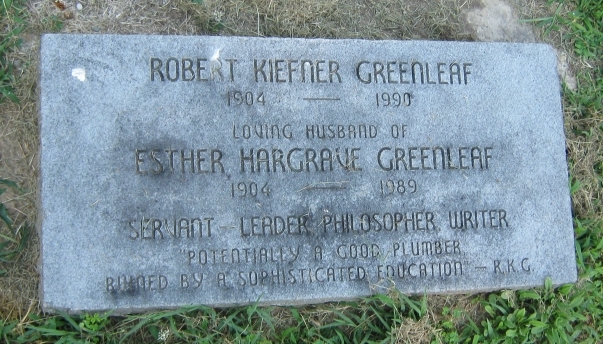
I know that Robert Greenleaf struggled with this question as well – his epitaph speaks volumes:

(in case the bottom is hard to read: “Potentially a good plumber, ruined by a sophisticated education”)

At the end of the day, plumbers can look back on a job well done, even point to the work accomplished. There is a satisfying finality, a recognized completeness to the labor.

Those of us tasked with leadership our impact is people, organizations, even communities. Sometimes there is an end task of our responsibility (i.e. a project, a key-performance indicator, a product, a vision) – but we are to help others achieve the task (otherwise we are not leading). The work is ongoing, and the results are intangible – sometimes even frustratingly elusive.

The founder’s proposal

So, how did Greenleaf resolve this tension, this internal anxiety? He proposed a framework of group assessment – acknowledging its problematic analysis:

The best test [of a servant leader], and difficult to administer, is: Do those served grow as persons? Do they, while being served, become healthier, wiser, freer, more autonomous, more likely themselves to become servants? And, what is the effect on the least privileged in society? Will they benefit or at least not be further deprived?

Robert K Greenleaf, The Servant as Leader

Greenleaf, in his economy of words, speaks volumes. In this short quote, he defines a number of elements that bear expansion:

  • Growth – Do those served grow as individuals, personally as well as professionally? The growth of followers is a distinctive feature of servant leadership.
  • Health – Are those served healthier, transformed into whole people. The active pursuit of healing forms the basis of the changes a leader brings to those being served
  • Wisdom – Do those served gain greater experience, knowledge, and good judgment while being served? Do they exhibit conceptualization and foresight in their own decisions?
  • Freedom – Are those served freer, both from their own blocks and inhibitions, and the external barriers placed on them?
  • Autonomy – Do those served have more control over their own decisions and lives? Are they empowered (and feel it)?
  • Leader continuation – Are followers being transformed into servant leaders? Replicating servant leadership in others is a profoundly satisfying result for a servant leader.
  • Common good – As a result of servant leadership, is society better off? Is community being built? Greenleaf suggests that servant leaders should seek out stakeholders that come from many different perspectives and lead with an eye on developing our impacted areas.

Using it it real life

I try to look at my impact using these hallmarks as a baseline to determine my impact, and assuage my questions. While Robert found it “difficult to administer”, I find that a patient, introspective assessment at how the group is doing according to these elements is important for my awareness; to find satisfaction in accomplishment or areas to improve (most often simultaneously).

And, it helps me sleep at night…